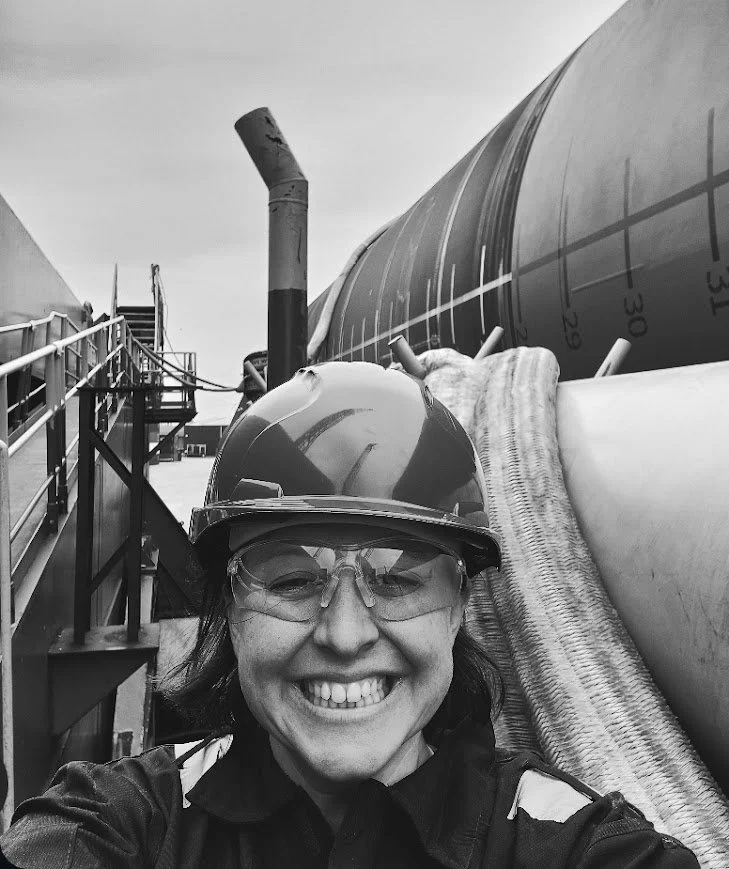
Saz Reed works through two businesses as a marine scientist, Marine Consent Manager and open water swim coach. Their work combines environmental management for offshore wind with practical offshore experience, including vessel operations, diving and surveying, alongside coaching swimmers to make better decisions around tides and weather.
Profile snapshot
Role: Marine Consent Manager / Marine Scientist / Open Water Swim Coach
Organisation type: Independent / freelance
Country / region: UK / Europe
Role type: Consultant; Founder / entrepreneur; Field practitioner; Coach
Focus areas: Renewable energy; Maritime; Oceanography; Education; Recreation; Policy and governance
Jump to
Your current role
What is your current role and what kind of organisation do you work for?
I am currently working through my own businesses as a marine scientist and open water swim coach. Through my company, Leven Environmental Ltd, I am contracted out to SSE Renewables working on the Dogger Bank Offshore Wind Farm projects as a Marine Consent Manager. Through this business, I also offer my skills as an offshore skipper, diver, surveyor and more if/when required. Through my business Swim With Saz, I combine all of my marine science skills and coach people in open water swimming, focusing on making better decisions on how the tide and weather influence swim planning.
What does a typical week look like?
I work 4 days a week and usually have Friday to Sunday completely off. I usually teach open water swimming before or after my day job at various locations around Lochaber, depending on the wind and tide. I then currently work Mon to Thurs for the Dogger Bank Project, where I take Teams calls and work on consent licence conditions to help build the offshore wind farm in the most environmentally sound way possible.
What skills do you use most often in your role, including any technical, practical, or soft skills?
My expertise is bridging environmental management with practical offshore experience. This happens daily in my role in making sure how we are discharging consent conditions can then be transferred to the offshore environment.
Every job has a best part and a worst part. What are they for you?
Overall, my job has so many good parts – the best part is seeing people progress when they swim and reach their goals or when I get to see how much power a wind farm is outputting to the grid. The worst part is genuinely hard for me to think about because I have built my life in the past 3 years to be doing what I want to do and how – I think maybe the worst bit is how many circles I have to go through in some of my jobs to get an answer or sign-off, but when you take a step back about why there are so many circles, then it usually makes sense, but some things could be streamlined!
What is one task you do all the time that never appears in job descriptions for these types of roles?
Thinking outside the box and networking/joining up minds.
What does this job demand of your schedule or lifestyle?
No demands. I am fully flexible as long as I attend the core meetings.
Who else do you work with or depend on to get your job done?
A whole suite of people from other offshore managers and leads, project managers, contractors, and vessel masters.
Your route into this work
How did you get into this work, and were there any key opportunities, decisions, or turning points along the way?
I moved my way along different roles, from a Ships Operations Manager, skipper and research technician at SAMS [Scottish Association for Marine Science], to then working in consultancy and field operations with Ocean Ecology Ltd, to then working with SSEN Transmission, where I re-entered the offshore world in a corporate role and when I set up my own business, I was contracted into SSE Renewables via a good pal from University. The main turning points for me have always been my prolific network and having a positive reputation for working within the offshore world and bringing a new perspective.
What education, training, or experience helped you get into this role?
A degree in Marine Biology and Oceanography from the University of Plymouth, but then to be honest, since it has been all my practical experience from my offshore vessel skipper’s ticket for power and sailing, my HSE IV commercial diving qualification, being a research technician on offshore vessels collecting samples and then networking and asking everyone questions, alongside reading everything from books, articles, blogs, LinkedIn posts, Twitter when that was a thing and more.
What is one opportunity you almost didn’t apply for, but are glad you did, and why?
I have always applied for everything I have wanted to do, it was more that I had a crossroads after being with the British Antarctic Survey, where I got offered a scholarship to advance my private pilot’s licence to a commercial licence to become a commercial pilot or head to SAMS and work in the Arctic on the DIAPOD project. I am very happy that I chose to go to SAMS – it was some of the best years of my life living on a wee Sadler 25 yacht in Dunstaffnage and making lifelong pals that taught me to mountain bike and more! SAMS is a lot more than just an incredible place to work for a while, it is a lifestyle.
Is there any education, training, or experience you wish you had done/gotten?
No but I am currently looking into advancing the sustainability and offshore environmental management side of the work I do at the moment.
Is there anything people think they need for this career that may not actually be essential?
Usually, if you think you tick most boxes on a role, you can learn the small percentage you don’t know whilst on the job.
Reflections and advice
What advice would you give someone interested in this kind of work, and where should they look for their first step?
If you are interested in working offshore, then check out getting an ENG1 medical [seafarer medical certificate] first and then all of your offshore tickets. If you are interested in the offshore wind world, check out all the resources at Renewable UK and OWEKH [a community of practice for offshore wind].
What is one mistake, challenge, or lesson from early in your career that taught you something useful?
One challenge I had was realising that someone’s quality of work in the role before me could have changed a long-term dataset, so I went about talking to the managers of each section to go back to how things had been done when the dataset was first started and how we need to get back on track to keep the dataset aligned. This taught me to always ask questions and come up with solutions, but to do it sensitively.
If you could go back in time would you do anything differently? If so, what would that be?
There are not many things I would change, except perhaps reporting a manager for bullying before moving on to a different role, before I watched things from afar escalate.
Where do you see this field heading, and what opportunities does that create for newcomers?
The offshore wind farm world is booming – come and join! There are so many opportunities depending on what type of role you are interested in (marine mammal observing, consents manager, environmental manager, offshore work and more), send me an email if you are interested.
Is there anything else you’d like to say?
For any career, if you don’t know an answer to something, don’t go around pretending you know it, just say you don’t know but then work damn hard to build your network so that you can ring or WhatsApp a pal or old colleague to help you in the right direction!
Connect and learn more
- Saz Reed's website
- Saz's Instagram
- Saz's email: sazreed [AT] outlook [DOT] com