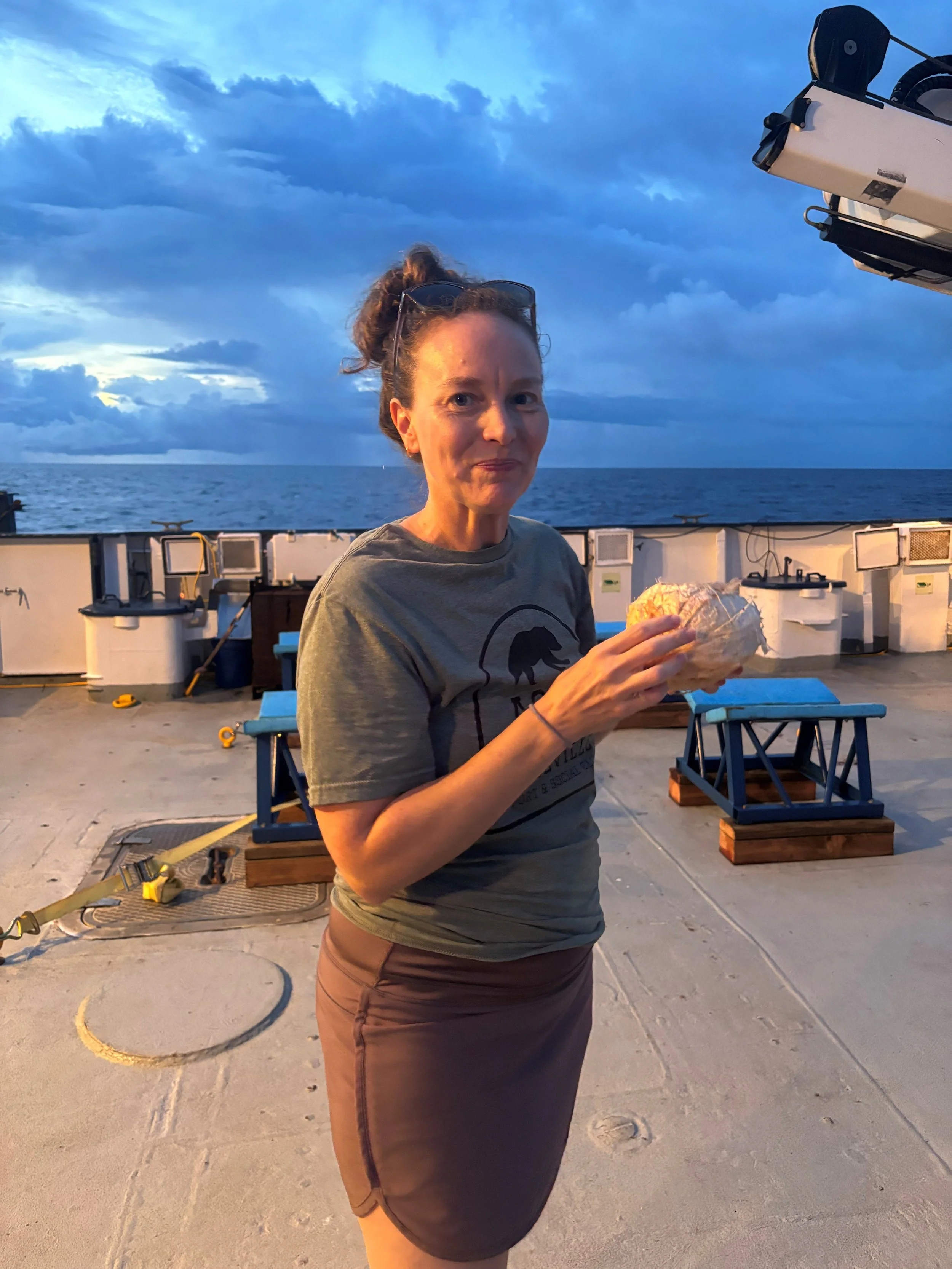
Amanda Bittinger works independently in ocean mapping and hydrographic survey, currently as Mapping Coordinator for Ocean Exploration Trust. Their work is expedition-based, with long periods at sea focused on data acquisition, processing, GIS, hydrography and mapping, alongside running their own business.
Profile snapshot
Role: Mapping Coordinator
Organisation type: Independent / freelance
Country / region: USA / North America
Role type: Data specialist; Field practitioner; Consultant; Founder / entrepreneur
Focus areas: Seabed mapping; GIS and mapping; Data; Oceanography; Maritime; Technology; Hydrography
Jump to
Your current role
What is your current role and what kind of organisation do you work for?
My current role is a contract position with Ocean Exploration Trust as the Mapping Coordinator. I have my own business, and this is one of many roles I have had working in the ocean mapping and hydrographic survey community. I have worked for nonprofits, private companies, and government agencies.
What does a typical week look like?
Typically, a contract is a 30-day expedition, four weeks plus travel. I work a 12-hour shift every day for the 30-day period. There are no weekends off. I work 120 to 160 days per year in this capacity, which is the same amount and sometimes more than a typical 40-hour work week for 52 weeks.
What skills do you use most often in your role, including any technical, practical, or soft skills?
Technical: data acquisition, analysis and processing, product deliverables and reports, data management, GIS [Geographic Information System], GNSS [Global Navigation Satellite System], acoustic theory
Practical: problem solving, logistics, teaching
Soft skills: clear communication, conflict management, time management, following directions, leadership skills
Every job has a best part and a worst part. What are they for you?
Best: finding new and interesting natural and anthropogenic features, traveling the world
Worst: Being away from home for extended periods of up to 3 months, very rough weather
What is one task you do all the time that never appears in job descriptions for these types of roles?
Accounting. I do my own bookkeeping for the business.
What does this job demand of your schedule or lifestyle?
Field seasons are generally May to October, with the occasional outlier.
I travel 4-5 times a year for 30 days at a time, sometimes more for remote locations.
Contracting started as on-call, meaning I would receive a call and be expected to leave in a day or two. I have moved into an area where clients are seeking me out on an annual basis after a few years of contracting. That is more stable.
Who else do you work with or depend on to get your job done?
I depend on the previous person in the role to leave me detailed handover notes.
I depend on my expedition lead and team members for calm, clear communications.
I depend on the captain and ship’s crew for safety of the vessel.
I depend on a friend who watches my house while I’m gone for long periods of time.
Your route into this work
How did you get into this work, and were there any key opportunities, decisions, or turning points along the way?
I started working near hydrography out of college. I earned an oceanography degree and then joined the NOAA Corps, where I learned to drive ships and participate in hydrographic surveys. I learned a lot about hydrography on NOAA Ship Rainier as an officer and then moved into private industry after separating from the uniformed service after six years. I continued to work on NOAA contracts. I was gone for summers. I did not see my family still, and I needed a change of lifestyle. I changed to freelance contracts after five years.
What education, training, or experience helped you get into this role?
I began with a bachelor's degree in oceanography. I later earned a Coastal Management Master’s degree. I have supplemented with a GIS certificate, and taken many other software or technical training courses to increase and maintain knowledge in a fast-moving industry.
While working for NOAA, I was trained to be an officer working toward management with courses and STCW [Standards of Training, Certification and Watchkeeping for Seafarers] trainings. While in private industry, I was trained by my peers with little outside of the office training. While working for myself, I provide the training and medical certifications.
My experience working with NOAA has opened a lot of doors in networking regarding NOAA contracts. And my experience as a contractor has opened a lot of doors working in other types of energy areas like offshore wind, and surveys done in different ways, like AUVs [autonomous underwater vehicles], USVs [uncrewed surface vehicles], and seismics that previously I did not encounter at NOAA.
What is one opportunity you almost didn’t apply for, but are glad you did, and why?
I almost did not do contract work. I was very discouraged by the way women were treated in the workplace. I took a short-term contract working for OARS Group, where I was placed on a Swedish ship for 4 weeks. I saw a different workplace dynamic that wanted me to participate in the capacity that I was. They did not care that I was a woman or American. We all worked together from many nationalities to get a job done, like clockwork, speaking in English. I am very grateful for that experience.
Is there any education, training, or experience you wish you had done/gotten?
I wish I had gotten a Master’s in hydrography. I chose an M.S. in coastal management for the remote sensing aspect, which is less valued by the community. There is a strong push for certification after 20 years of experience that I am unable to apply for because I don’t have the syllabus to support my transcripts. At the time of studying, it was the best choice, because I completed it while working full time remotely.
Is there anything people think they need for this career that may not actually be essential?
This career is a jack of all trades and master of none. There is literally nothing that doesn’t apply with regard to STEM. It will branch you in a direction to utilize those skills.
Reflections and advice
What advice would you give someone interested in this kind of work, and where should they look for their first step?
Decide what kind of life you want to live in 20 years and start working toward that, and do not let it go. People will try to talk you out of what you want for their own benefit and comfort. Don’t let them. Don’t quit on yourself.
Get a strong foundational bachelor’s degree (math, engineering), and if you like mapping, get the master’s in that so that you have a certification that is recognized by the hydrographic community.
If you could go back in time, would you do anything differently? If so, what would that be?
I would choose to do so many things differently, and yet if I did choose them, I would not have learned what I did.
Where do you see this field heading, and what opportunities does that create for newcomers?
This field is heading toward autonomy like many others. This is creating more remote opportunities for newcomers.