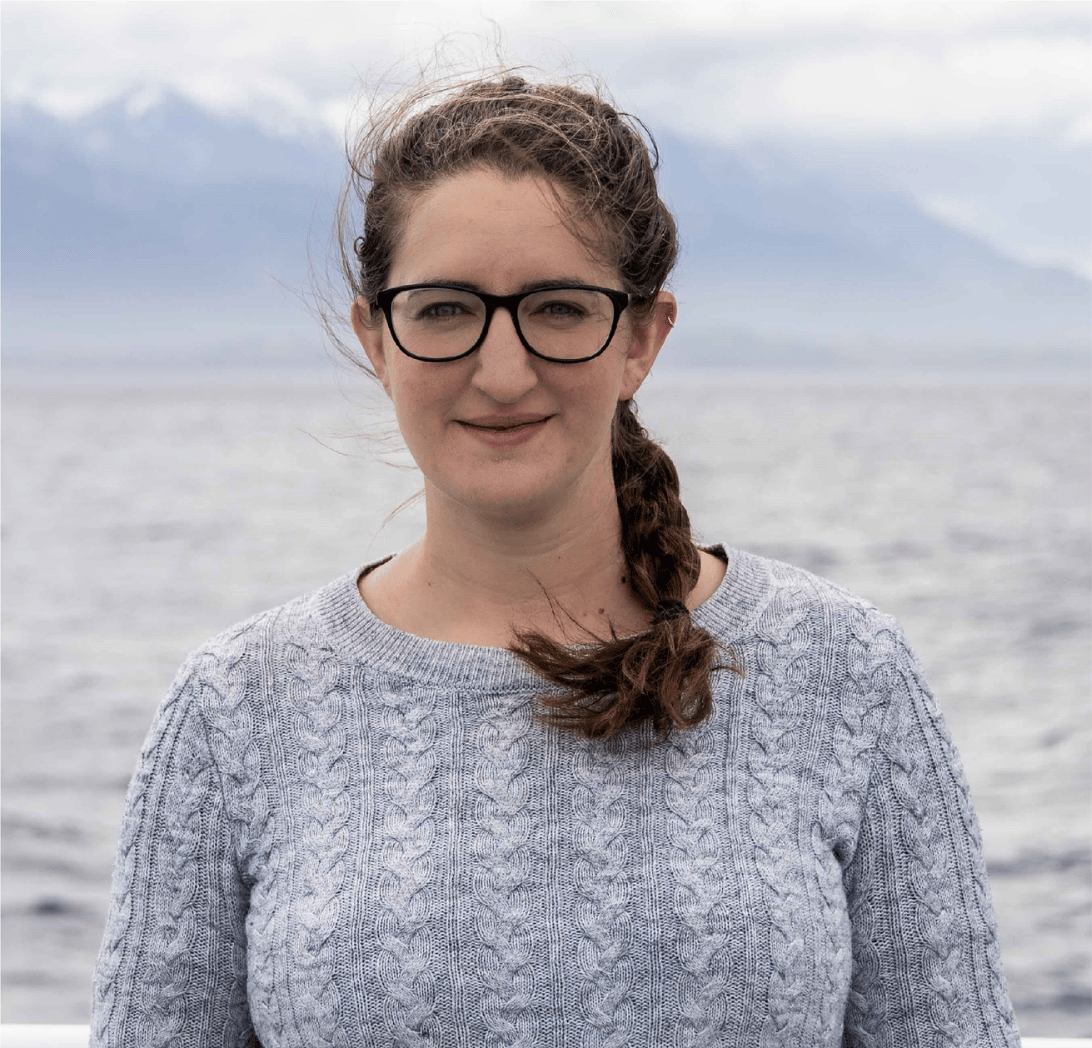
Rachel Hale is a Marine Ecologist at Earth Sciences New Zealand, a public research organisation in Aotearoa New Zealand. Their work combines data analysis, scientific writing, grant proposals and research with fieldwork ranging from coastal sampling to multi-week research voyages and work in the Pacific.
Credit: Lana Young/ESNZ
Profile snapshot
Role: Marine Ecologist, Earth Sciences New Zealand
Organisation type: Research institute
Country / region: New Zealand / Oceania
Role type: Researcher
Topics: Marine life, Oceanography, Climate change, Taxonomy; Research
Jump to
Your current role
What is your current role and what kind of organization do you work for?
I am a Marine Ecologist working for a “Public Research Organisation” in Aotearoa New Zealand. I work for Earth Sciences New Zealand (ESNZ).
What does a typical week look like?
I would say my typical week mostly consists of computer work that consists of writing reports or papers, data analysis, or writing proposals to get funding.
However, I would say I have many weeks that are atypical that involve me being at sea on a large scientific research vessel, working coastally from the shore or on small boats, or working in the Pacific.
What skills do you use most often in your role, including any technical, practical, or soft skills?
The skills I use most are probably technical and persuasive writing skills, so presenting and arguing a hypothesis based on my data in a report or paper, or writing a grant proposal. Practical skills for running experiments and collecting data are also very useful. Behind the scenes there are lots of soft skills needed as many things boil down to personal relationships to get things done as a team.
Every job has a best part and a worst part. What are they for you?
I really like writing papers and proposals – really digging down into the detailed science to discover new things or propose new things. But on the other side, the time it takes for papers to be reviewed (although understandable at the moment) and to hear whether your grants have been successful is frustrating. Sometimes it feels like things can move so fast, and then so slow.
What does this job demand of your schedule or lifestyle?
The voyages I go on are sometimes long – up to 4 weeks, although they can be longer. The Pacific fieldwork is 2 weeks or more. What is difficult is when these run together so I have a period coming up with 2 weeks conference, 2 weeks fieldwork, then a week voyage with a few days in between each which means lots of bitty travel and time away from home.
Who else do you work with or depend on to get your job done?
So many people. There are so many skilled people at ESNZ and across New Zealand whose skills complement my own. I love working with people with different specialities that provide different perspectives on my work. They are also great for writing grant proposals with to make sure what I write is widely understandable, and vice versa. I also work closely with many highly skilled technicians at ESNZ who facilitate and help with everything I do, and I really appreciate their time and expertise!
Your route into this work
How did you get into this work, and were there any key opportunities, decisions, or turning points along the way?
I loved looking for invertebrates at the beach as a child, so I just pursued a path that would allow me to identify what I could see. Key points were mentors I acquired along the way (although I didn’t see them as that at the time) who provided help developing my skills or opportunities. My master’s project that involved looking at how ocean acidification and temperature will impact benthic invertebrate communities allowed me to learn how to identify lots of invertebrates and showed me that research was something I really enjoyed and wanted to take further. I turned a key opportunity down to keep my focus on benthic species, which was risky at the time but thankfully it paid off in the long run.
What education, training, or experience helped you get into this role?
I have the traditional bachelor’s, master’s, and PhD, but I’ve also worked in a museum role and as an environmental consultant, which help with the diverse work I do now at ESNZ. Having a good grounding in statistics is always useful! I do scuba dive but I have never had to for my work at ESNZ – so you definitely don’t need to do scuba training to be a marine biologist.
Is there any education, training, or experience you wish you had done/gotten?
At the moment I would like to do some training in scientific communication to improve my communications as so much of the science we do ends upo in paywalled or technical terminology dense journal articles which are not very accessible (although just want to add in the reminder that if you can't access a paper online due to a paywall, always email the author and they should be happy to send you a copy and talk about their science!).
Our science should be useful to society or at least interesting to society and being able to communicate that and pass our findings on is the next step in what we do, particularly with regard to influencing policy and enacting change. Specialist training in how to communicate to different audiences (the public, policy makers, other scientists) would provide some really useful skills. This includes knowing what medium to communicate to your audience in as well. For policy makers this may be condensed one-page summaries but for the public and those that don't consume printed media it may be podcasts and radio interviews.
Is there anything people think they need for this career that may not actually be essential?
As above, scuba training is not essential. It’s great for data collection (in some places) and fun, but the majority of my samples are collected wading on the mudflat or from on board a ship, so it’s definitely not needed. You can work on ocean data or make a conservation difference any way you like – be it completely landlocked, on a ship, in a tent in Antarctica, or scuba diving. Marine biology and related careers have so many variations.
Reflections and advice
What advice would you give someone interested in this kind of work, and where should they look for their first step?
If you are interested in this kind of work, then getting some experience is always good. For me, that consisted of the work and research I did for my undergraduate and master’s projects, but it could also be working with local organisations and companies in trainee roles. For academic roles, the academic qualifications will be necessary, but for being a marine biologist or working in ocean conservation, that isn’t always necessary, and job paths take many forms.