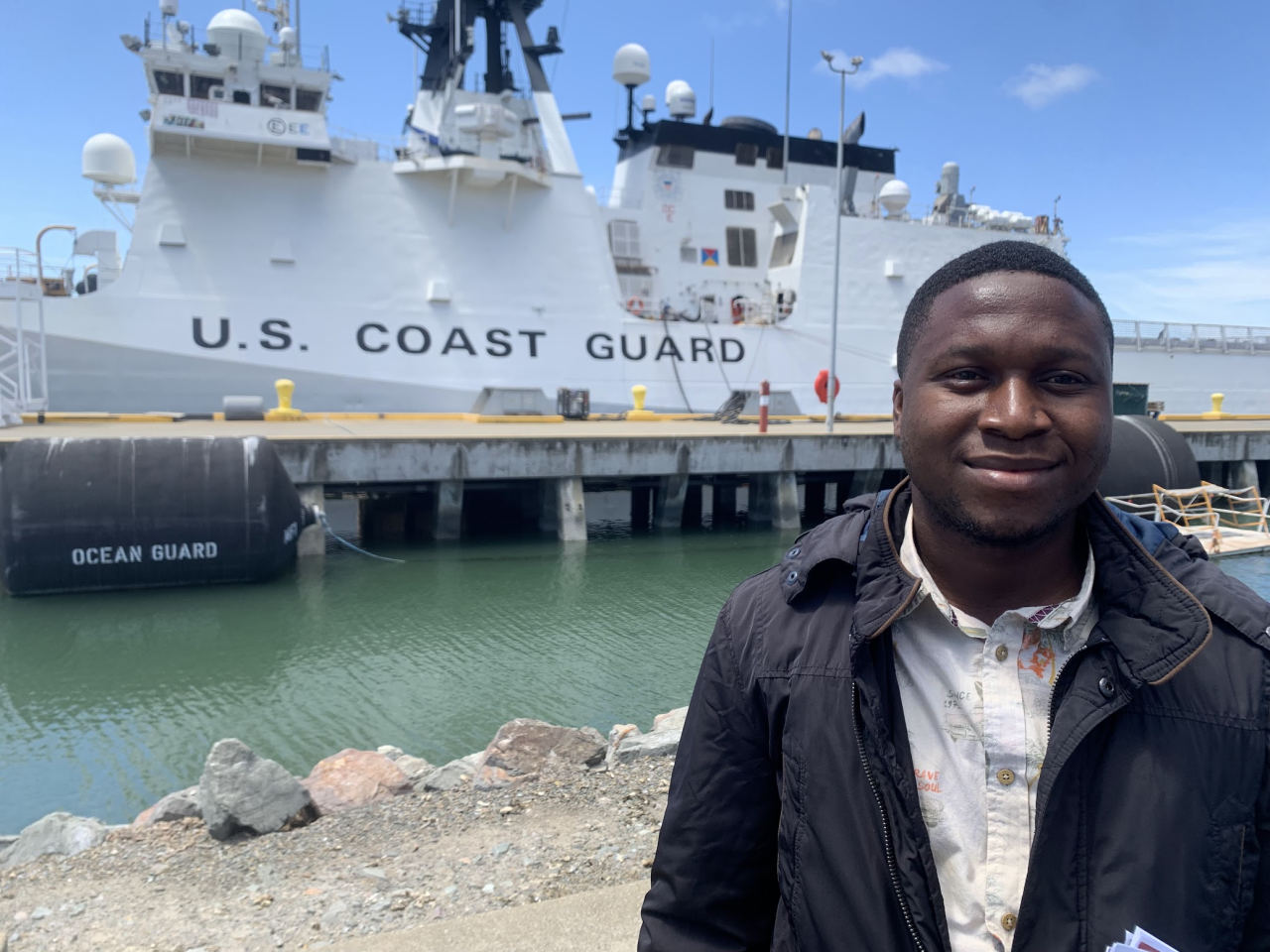
Kusi Boateng works with the Ghana National Canoe Fishermen Council, representing small-scale and artisanal fishers in Ghana, with a current focus on illegal, unreported and unregulated fishing and sustainable fisheries management. Their career has moved through fisheries observation, USAID-funded programmes and FAO project coordination into work combining fisheries governance, community engagement and policy. For readers interested in fisheries careers, the profile shows how technical fisheries training can develop into work centred on people, institutions and practical management.
Profile snapshot
Role: Fisheries management, Ghana National Canoe Fishermen Council
Organisation type: Professional Association
Country / region: Ghana / Africa
Role type: Community engagement; Policy
Topics: Fisheries and aquaculture, Coastal communities, Policy and governance, Stakeholder/community engagement
Jump to
Your current role
What is your current role and what kind of organization do you work for?
I currently work with the Ghana National Canoe Fishermen Council (GNCFC), which represents small scale and artisanal canoe fishers in Ghana. My current work focuses mainly on addressing illegal, unreported and unregulated fishing in the small scale fisheries sector, working closely with fishers, government agencies, development partners and other stakeholders to identify practical ways of improving compliance and sustainable fisheries management.
Before joining GNCFC, I worked with the Food and Agriculture Organization of the United Nations (FAO), where I coordinated the implementation of two fisheries and aquaculture projects. The role involved both field and desktop work, including preparing budgets and work plans, coordinating with government institutions, research organizations, district authorities, communities and other stakeholders, monitoring activities, analysing information, preparing reports and providing technical and operational support to ensure that project activities were delivered as planned.
A significant part of my career has also been spent working on USAID funded fisheries management projects, where I gained extensive experience in sustainable fisheries management, community engagement, fisheries governance and working with different groups within the fisheries sector. Earlier in my career, I also worked as a Fisheries Observer, which gave me practical, first hand experience of fishing operations and helped me understand the realities of fisheries management from the water.
What does a typical week look like?
There really isn't a completely typical week, and that is one of the interesting things about working in fisheries.
Some weeks are mainly spent in meetings and discussions with government agencies, fishing communities, development partners and other organizations. We may be discussing illegal fishing, fisheries regulations, community concerns, or ways of improving the livelihoods of small-scale fishers.
Other weeks involve field visits. I may travel to fishing communities, meet directly with fishers and community leaders, observe activities at landing sites, collect information and discuss challenges affecting fishing communities.
There is also quite a bit of writing and analysis involved. I prepare reports, review information, contribute to project planning and develop recommendations. So my work is really a combination of fieldwork, meetings, research, coordination and problem-solving.
What skills do you use most often in your role, including any technical, practical, or soft skills?
The most important skill is probably communication. Fisheries involves many different people with different interests, from individual fishers and community leaders to government officials, researchers and international organizations. You have to be able to explain issues clearly and, just as importantly, listen to people.
I also use project coordination and planning skills a lot. Many fisheries problems cannot be solved by one organization, so I often have to bring different stakeholders together and help coordinate their efforts.
My technical fisheries knowledge is also important. My academic background is in fisheries and coastal zone management, and I have practical experience with fisheries monitoring, biological data collection, species identification and fisheries management.
Another important skill is adaptability. Fieldwork does not always go according to plan. You may arrive in a community and discover that the situation is different from what you expected. You have to listen, understand the local situation and adjust your approach.
Every job has a best part and a worst part. What are they for you?
The best part is working directly with people and seeing an idea turn into something practical. I particularly enjoy working with fishing communities because you learn a lot from their experience. Fishers have an understanding of the ocean that comes from years of being on the water, and combining that practical knowledge with scientific information can produce much better solutions.
The difficult part is that fisheries challenges are complex and often take a long time to resolve. There can be disagreements between stakeholders, limited resources, and sometimes a gap between policies and what is actually happening on the ground. It can be frustrating when you know what needs to be done but the process of getting everyone to agree and act can take time.
However, that has also taught me patience and the importance of building relationships rather than expecting quick solutions.
What is one task you do all the time that never appears in job descriptions for these types of roles?
A large part of this work is making sure that things actually happen after a meeting or agreement. You may have ten people agree on an action during a meeting, but someone still has to call, send the reminder, check the progress, clarify an issue and bring everyone back together.
It sounds simple, but effective follow-up is one of the things that makes projects work. I've learned that good coordination is not just about having good ideas; it is about staying with those ideas until they produce results.
What does this job demand of your schedule or lifestyle?
Fisheries work requires flexibility. Field visits can mean travelling to remote coastal communities and spending long periods away from the office. Sometimes meetings or activities have to be scheduled around the working patterns of fishing communities.
You also have to be comfortable working in different environments and dealing with changing circumstances. A plan that looks straightforward from an office can become very different once you are in the field.
For me, that is part of the appeal of the work. I enjoy combining office-based analysis and planning with practical field experience.
Who else do you work with or depend on to get your job done?
Fisheries is very much a collaborative field. I work with or depend on government institutions such as the Fisheries Commission, district authorities, traditional leaders, fisher organizations, researchers, development partners and civil society organizations.
Most importantly, I work with the fishers themselves. They are not simply people who receive fisheries policies; they are directly affected by those policies and have an important role in making fisheries management work.
Your route into this work
How did you get into this work, and were there any key opportunities, decisions, or turning points along the way?
My route into fisheries started with my academic background. I studied Fisheries and Aquatic Sciences, which gave me my technical foundation, and later pursued a master's degree in Coastal Zone Management.
The important turning point was moving beyond the purely technical side of fisheries into work that involved communities, governance and policy. I realized that having scientific knowledge about fisheries is important, but it is not enough. You also need to understand the people who depend on those resources and the institutions responsible for managing them.
Working on USAID-funded fisheries programmes was particularly important for me. It gave me the opportunity to work directly with fishing communities, government agencies and other international partners on real fisheries problems.
One of my most significant experiences was my involvement in Ghana's Stop Saiko campaign, which brought together fishing communities and other stakeholders around the problem of illegal fish transshipment. I also supported the establishment of community-based enforcement structures along Ghana's coast, specifically Landing Beach Enforcement Committees (LABECS).
Later, working with FAO gave me another opportunity to work at a broader programme level, coordinating fisheries and aquaculture activities and working with different government and development partners.
Looking back, my career has gradually moved from understanding fisheries technically to helping people and institutions find practical solutions to fisheries problems.
What education, training, or experience helped you get into this role?
My BSc in Fisheries and Aquatic Sciences gave me my core technical knowledge, while my MSc in Coastal Zone Management broadened my understanding of how human activities, environmental issues and natural resources are connected.
But some of my most valuable learning has come from experience. Working directly with fishing communities taught me things that cannot be learned fully in a classroom, especially how communities respond to regulations, how to build trust, how to manage disagreements and how to turn technical information into something people can understand and use.
My work with USAID programmes, FAO and the Fisheries Commission also exposed me to project management, fisheries monitoring, community engagement, policy discussions and stakeholder coordination.
I have also participated in international professional development, including the International Visitor Leadership Program of the U.S. Department of State, which gave me an opportunity to learn from fisheries and conservation approaches outside Ghana and build relationships with professionals working on similar issues.
What is one opportunity you almost didn’t apply for, but are glad you did, and why?
One opportunity that stands out is the International Visitor Leadership Program (IVLP) experience with the U.S. Department of State.
It exposed me to new approaches to fisheries management and allowed me to interact with professionals working on fisheries and conservation issues in the United States. More importantly, it encouraged me to think beyond my immediate work environment and consider how ideas from different contexts can be adapted to Ghana.
The experience later contributed to my securing an IVLP Impact Award, which I used to implement a fisheries empowerment initiative. That showed me that sometimes an opportunity can have much more impact than you initially expect.
Reflections and advice
What advice would you give someone interested in this kind of work, and where should they look for their first step?
My biggest advice would be don't limit yourself to the classroom.
Education is important, but fisheries and ocean conservation are practical fields. Try to get as much hands-on experience as possible. Volunteer with an organization, participate in fieldwork, work with fishing communities, support research projects or look for internships with government agencies, universities, NGOs and development organizations.
I would also encourage young people to develop skills beyond their technical subject. Learn how to communicate, write reports, analyse information, manage projects and work with different types of people. These skills become extremely important as you progress in your career.
Most importantly, don't be afraid to start small. My own career developed through different opportunities, and not every position was my ultimate goal. Each experience gave me another skill or connection that became useful later.
For someone interested in this field, I would start by looking at opportunities with fisheries agencies, conservation organizations, research institutions, development organizations, universities and community-based organizations. Also pay attention to internships, short-term projects and volunteering opportunities. Your first opportunity does not have to be your dream job; it can be the door that gets you closer to it.
Where do you see this field heading, and what opportunities does that create for newcomers?
I think the field is moving toward a much stronger connection between ocean conservation, climate change, food security and people's livelihoods.
We can no longer look at fisheries simply as catching fish. We have to think about healthy oceans, sustainable fishing, climate change, coastal communities, markets, food security and decent livelihoods as connected issues.
That creates opportunities for young professionals with different backgrounds. We need fisheries scientists, conservation specialists, data analysts, economists, communications professionals, project managers, policy specialists and people who can work directly with communities.
I also think technology will become increasingly important. Better data collection, digital monitoring and new ways of understanding changes in marine ecosystems will create opportunities for people who can combine technical knowledge with technology and practical field experience.
Is there anything else you’d like to say?
I would simply say that a career in fisheries and ocean conservation is much more than working with fish.
For me, it is about people, livelihoods, food security and the health of the environment. A fishing community may depend on the ocean for almost everything, so when fisheries are poorly managed, the consequences go far beyond declining fish stocks.
What keeps me interested in this work is the opportunity to be part of finding practical solutions that protect marine resources while also recognizing the needs and realities of the people who depend on them.
My career has taken me from fisheries science to community work, conservation, fisheries governance and international development. I am still learning, but I remain passionate about contributing to a more sustainable and equitable future for Ghana's fisheries and coastal communities.