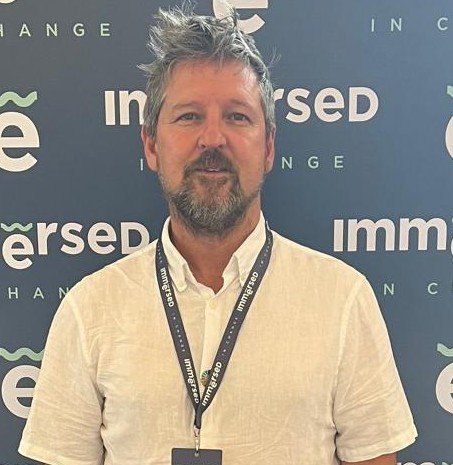
Matthew Frost is Head of the Office for International Affairs at Plymouth Marine Laboratory (PML), an independent marine research charity in the UK. His work connects marine science with policy, international affairs and diplomacy, helping scientific evidence feed into global ocean discussions and decision-making.
Profile snapshot
Role: Head of the Office for International Affairs
Organisation type: Research institute
Country / region: United Kingdom / Europe
Role type: Policy specialist; Director / senior leader
Focus areas: Policy and governance; Science communication; Stakeholder/community engagement; Oceanography
Jump to
Your current role
What is your current role and what kind of organization do you work for?
I work for Plymouth Marine Laboratory in the UK, which is an independent marine research charity with about 150 staff of which c. 100 are core scientific staff. My role is as Head of the Office for International Affairs.
What does a typical week look like?
I simply don’t have a ‘typical week’. As an example, until last week I was working out in Bamfield, Vancouver Island, Canada at the World Congress of Marine Stations as I chair the body that brings representatives from the world’s marine stations together. This week I have been contributing to grant proposals for Horizon Europe, writing a Horizon Scan for a High-Level Government Panel, planning a meeting for the High Seas Treaty and another government led event in 2027, writing a document for a meeting on solutions to meet the United Nations Ocean Decade Challenges and meeting with colleagues internally to catch up on a multitude of activities. Next week I am meeting a visiting MP, co-chairing some international meetings and then heading off to the United Arab Emirates to Chair an International Advisory Board.
My job is ‘incredibly’ varied from day to day and week to week so ‘typical’ doesn’t even come into it.
What skills do you use most often in your role, including any technical, practical, or soft skills?
The main skills I use are diplomacy and communication backed by my knowledge of marine science and global ocean policy and governance. My job really is to create networks, make connections and ensure marine science is influencing and feeding into the global agenda. I do a LOT of communicating so this skill is vital, whether it is presenting to an audience, writing scientific papers and policy briefs or giving interviews to the media.
Every job has a best part and a worst part. What are they for you?
The best part is feeling that I am having an impact by working at what is often referred to as the science-policy interface or more recently the science-policy-diplomacy interface. Working with organisations across the globe from scientists to embassy staff, government ministers and civil servants and staff from United Nations bodies always makes me feel I am doing my best to get PML’s science to where it matters so we can hopefully make a difference.
The worst part is probably the same as any job in that there is a lot of administration, reporting and other bureaucracy that is necessary to facilitate all the above so I still have to do this, which can be difficult when you are constantly busy and on the move.
What is one task you do all the time that never appears in job descriptions for these types of roles?
Diplomacy related decisions: most people who are in my line of work (international Affairs, global engagement / networking) are not professional diplomats i.e. paid by their home country to represent the official position of their government but nevertheless have to utilise diplomatic skills regularly. Especially in recent years as things have become challenging from a geopolitical point of view then questions arise all the time such as what countries we should be working with and how for example. When I travel I need to be thinking about issues such as which maps to use in presentations, what names should I give to countries, territories and sea areas. When I am making connections and helping make contacts I need to make sure this is done in an appropriate way and connect the right people.
What does this job demand of your schedule or lifestyle?
This is a job that requires a high degree of dedication and commitment. If you want to clock in at 9 and out at 5 each day and have issues working out of hours then it really isn’t for you. I travel constantly and because of working with people across multiple time zones you have to be prepared even when in the UK to meet at odd hours! Being flexible is absolutely vital as things change all the time and you are often responding to developments at short notice and reprioritising constantly. Again, if you are someone who wants predictability then this isn’t the role for you!
Who else do you work with or depend on to get your job done?
I have a deputy in my department who is great but I work across the organisation on this. It is not a job that can be done by one person as I need all the other skillsets, expertise and the variety of scientific knowledge that exists in the organisation.
Your route into this work
How did you get into this work, and were there any key opportunities, decisions, or turning points along the way?
I was inspired when I was young about the possibility of being a marine biologist after seeing the film ‘Jaws’ and realising that marine scientist was actually a job (the character in the film was ‘Matt Hooper’). I was interested in a lot of other things too so didn’t come to it directly but after working in some scientific government agencies after my A levels, including working with a marine science survey team, this stimulated my interest even more and confirmed my route into this field.
In terms of the Policy and International Affairs I focus on now, I was always the person who would sit through science talks, put my hand up and say ‘so what’ (in a manner of words) – I wanted to know what was being done with the information we were producing and how it could be used to make a difference. I was approached by someone early in my career from the UK Government to see if I wanted to work on a project that coordinated a marine science network and, most importantly, then reported on how it could inform policy. I said yes (this work covered half of my salary) and then moved onto coordination and reporting at a European and then global scale.
What education, training, or experience helped you get into this role?
I did a degree in Marine Biology and then after doing a marine ecology focused PhD I realised that it was the ‘so what’ element of what I was doing that inspired me. I also realised that I was a generalist – I didn’t want to devote my life to one or two areas of marine biological research. As part of my ‘pivot’ towards a more policy focused role I went on quite a few training courses including doing a placement with UK Parliament but a lot of it was learning on the job by for example attending UN and other globally focused meetings or working alongside colleagues in government. Because the job is so varied and policy and geopolitics is such a dynamic field, you have to be prepared to keep learning all the time. It is not a job that you do one piece of training for or get one qualification and that’s it for life.
What is one opportunity you almost didn’t apply for, but are glad you did, and why?
I am so glad I applied for the Royal Society Pairing Scheme as I got to work very closely with MPs and others and even get to hear how COBRA works and other parliamentary mechanisms. This really opened my eyes to how the UK government and parliament operate and how best to engage from a scientific POV.
Is there any education, training, or experience you wish you had done/gotten?
I think I did everything I could within the time available based on the opportunities that appeared. I had some opportunities to work in other places across the globe that I had to turn down for personal reasons so I don’t regret that at all but I know it would have been useful – especially in terms of developing language skills. In fact I wish I had spent longer working on becoming multi-lingual (other than English I speak French to a small degree but no other languages beyond the absolute basics). I think working globally means you should always try and learn some basics at least as its about respect for the people in other countries. There are also some jobs internationally that stipulate that you are fluent in at least two languages and I am always embarrassed by how many languages most people speak once you get outside of the UK.
Is there anything people think they need for this career that may not actually be essential?
The main thing is that I know so many people who have ‘pivoted’ in their careers so don’t feel you need to have the absolute specific qualification to work in a particular area. I was talking to someone recently who studied International Affairs and had ended up working in marine conservation whereas I had made the opposite journey. There are so many transferable skills and most organisations are far more multi-disciplinary now than they used to be. We have a huge variety of skillsets at PML so don’t think you couldn’t possibly work in a marine science organization if you didn’t study marine biology or think that you couldn’t work in policy or international affairs if you have mainly a science background! Obviously it helps if you know what you want to do and train for that but lifelong learning is now much more embedded in the way we have one, two or multiple careers over a lifetime so don’t feel restricted.
Reflections and advice
What advice would you give someone interested in this kind of work, and where should they look for their first step?
I would first approach people directly who do this type of work already and see if they have time for a chat. Not everyone would be able to do this but most people are pleased to chat over a coffee and give some guidance. Getting inside information is so important as a lot of jobs are very different on the inside than they appear to those looking in (it amazes me how many people think all marine biologists while away their days swimming with whales and turtles or counting fish on coral reefs despite there being a huge variety of jobs in this field). There are a lot of resources, volunteering opportunities, internships and other things that can be found through searching online but I think trying to get a direct connection to people or organisations is always best if possible. This also means doing some homework on what organisations and people are in this field.
What is one mistake, challenge, or lesson from early in your career that taught you something useful?
I learned not to carry on in a role you are not enjoying if there is a way to move towards what you really want to do. I know not everyone has a choice (we all have bills to pay and we need the opportunities to be there!) but where there is choice then be proactive – discuss with your boss / organisation if you can take your role in a slightly different direction and demonstrate the value of that work. There are many jobs where you sign up to do specific tasks exactly as prescribed but there have been many occasions where I was doing something I didn’t think I was particularly good at and worked to develop the role differently so I became much more effective in doing that with my regret being I didn’t do it sooner.
If you could go back in time would you do anything differently? If so, what would that be?
I don’t really have any regrets as I am enjoying what I do immensely and have had a rewarding career. Even things that didn’t work out in terms of jobs or roles were all learning experiences.
Where do you see this field heading, and what opportunities does that create for newcomers?
When I started my career many marine scientists would not have thought about engaging with policy but that is fairly standard now for most organisations and people. I think we are moving in the same direction with International Affairs and diplomacy. Many of the challenges we face in the Ocean are global in nature, requiring working across borders with people across the world. I hope this means there will be more roles in this field.
Is there anything else you’d like to say?
I have seen many people with a very narrow idea of what working in the ocean sector means, usually linked to some sort of academic pathway. There are actually loads of other opportunities from working with industry, publishing, media, policy, government, education, international affairs and a host of others. So be open to how your personality, experience and skillset can be used in multiple ways to contribute to this field.