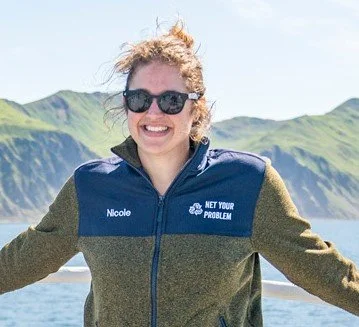
Nicole Baker is Executive Director of Net Your Problem Foundation, a US nonprofit that collects discarded fishing nets and line from the maritime industry and sends them for recycling. Having started the organisation as a for-profit business, Nicole’s work now spans logistics, fundraising, relationship-building, outreach, physical handling of fishing gear, and organisational management. The profile gives a candid look at what it takes to build and run an environmental organisation from scratch, including the financial pressure, practical problem-solving, and sheer variety involved.
Profile snapshot
Role: Executive Director at Net Your Problem Foundation
Organisation type: NGO / nonprofit
Country / region: USA / North America
Role type: CEO / executive leader; Founder / entrepreneur
Topics: Pollution (including plastic); Maritime industry; Operations and Coordination; Fisheries; Stakeholder engagement;
Jump to
Your current role
What is your current role and what kind of organization do you work for?
I am the Executive Director of Net Your Problem Foundation, which is a 501c3 non-profit that collects net and line from vessels in the maritime industry and recycles them. I started Net Your Problem as a for-profit business in 2018, but we shifted to a non-profit in February 2024 because it removed a lot of barriers we had encountered over the years as an LLC (limited liability company).
What does a typical week look like?
It depends on the time of the year, we do a lot of collecting in the summer, shipping in the fall, planning in the winter and preparing in the spring, but right now Im answering these questions on an airplane (a 6h 45 min flight from Chicago to Anchorage) where I have just blew through probably 50 unread emails – it is a great use of the $8 WiFi – that covered the following topics: producing a 1 min video for a trade show booth, thanking donors for their contributions, making a 6 month budget for the organization and scheduling a bunch of meetings. My favorite meeting invitation was from someone who recommends ropes to customers, and they want to include the recyclability of it in their considerations.
There are other weeks where I spend no time on the computer and am just spending 10 hours a day sorting through, cleaning, baling and loading nets into containers so they can get sent to a recycling facility, and I also spend time at conferences. My September looks like this: spend three days at a rodeo running an education/fundraising booth, then fly to Vietnam to visit a new recycling facility, then go to Maine for a panel presentation but stop in Seattle to have a Board meeting on the way. I love the variety and can really spend my time how I like and on what I think is most important at the time because there is never nothing to do.
What skills do you use most often in your role, including any technical, practical, or soft skills?
I don’t know what the technical term for general bullsh!tting is, but there is a lot of that in this job. I am always meeting new people around the country who would like to know what we are doing, we walk the docks trying to get vessel owners to use our services and we are working on building relationships with new donors. I use Canva a lot to develop attractive-looking slide decks and one-pagers and postcards that will catch people’s eyes and they will actually read that describe our mission and impact, and I write proposals and budgets for family foundations and grants and to businesses I want to sponsor us. It’s very different than the scientific writing I was trained to do in my formal education (I have a master’s in marine biology from a University in Puerto Rico) but it gets easier every time I do it.
The things that I don’t like doing, or don’t want to learn, or are not good at (think taxes, accounting etc) I pay others to do, so I think that delegating is also a skill that a manager needs to have. There is a component of manual labor to this job, and also an incredible amount of logistics (think buying and shipping supplies up months in advance, organizing trucking, shipping and just thinking about all the things you need in order to do a project, and then when those things need to be done by and what needs to be done first so that other things can happen – either by me or others). I make a lot of lists 😊
Every job has a best part and a worst part. What are they for you?
Best part is hands down when someone at first thinks nah Nicole, I’m not going to do this, too much work, takes too long, isn’t worth it – and then after spending some time with them explaining why it is worth it and how they can modify their behaviour and walking them through the recycling process and having them hold in their hand a knife made from recycled net plastic – that moment when their brain clicks and their eyes shine is so worth all the headaches. And there are certainly a lot.
The financial stress I think is the worst. We know what to do. We know how to do it. All we need to get is the money to do it. And when we were a business, I took $50,000 out of my personal retirement fund to keep this thing going. I sacrificed a lot personally – I gave it all of my time and money because I believed in it and I hope the rewards for all the hard work and planning and perseverance will pay off.
What is one task you do all the time that never appears in job descriptions for these types of roles?
Go to the post office. I don’t know why, but I feel like I am always sending samples places or picking up supplies or swag.
What does this job demand of your schedule or lifestyle?
Holidays and weekends are ignored. Traditional 8-hour workdays with a 10-minute break before lunch and a 30-minute paid lunch are nowhere to be found. We work till we get the job done, and nothing ever goes to plan, so it always takes longer or requires us to do something different than we thought and problem solve on the spot. That’s just part of it, so you have to be able to go with the flow.
Who else do you work with or depend on to get your job done?
We work with recycling companies, trucking companies, governmental agencies at the local, state and federal level, Tribes, other non-profits and businesses. We say we work with anyone and everyone who is interested in helping us advance our mission, which is to build a national movement of maritime businesses who are committed to improving their operational sustainability for the benefit of their communities and the waters where they operate.
Your route into this work
How did you get into this work, and were there any key opportunities, decisions, or turning points along the way?
I used to work as a scientist on fishing boats in Alaska, and read a story about Adidas making a sneaker from recycled plastic from fishing nets. I was literally surrounded by piles of them in Dutch Harbor and two years after reading that story, I read on Twitter that a group from the Netherlands was sending nets to Denmark to be recycled, so I thought we should be doing the same from Alaska. In 2017, I sent 6 containers, and it has only grown from there.
What education, training, or experience helped you get into this role?
I have a master’s degree in marine biology that I barely use. My bachelor’s degree is what got me into the fisheries observing job where I first saw all the old nets lying around, but I have learned what I know now because I have needed to know it. I didn’t go to school for logistics or supply chain management, but I book trucks and shipping containers and export things regularly – you just figure out how to do it yourself or how you can pay someone to do it who does know.
Is there anything people think they need for this career that may not actually be essential?
All the people I have hired to work with me at Net Your Problem have not known a thing about how to collect and recycle plastic. What they have had that made me hire them is a certain attitude about how to problem solve, that we don’t take no for an answer, that it’s ok if everything doesn’t work out as we plan, and they understand or are involved in the maritime industry to some extent. You definitely don’t need to show me your diploma if you can get sh!t done 😊
Reflections and advice
What advice would you give someone interested in this kind of work, and where should they look for their first step?
The career advice I give often as someone who started an organization (doesn’t matter what kind) is that if you want to do something, but it doesn’t exist, just start it. It literally cost me $50 to register Net Your Problem with the State of Alaska Department of Commerce when I first got started. I was a sole proprietor first, then switched to an LLC and am now a non-profit. So I didn’t have it all figured out at the beginning and you don’t have to either. Just try!
I was still working at a University when I started, and I would encourage people to do that – work any kind of job to pay the bills and then work you’re a$$ of at night and on the weekend to start something new if you cant find an organization to work for doing what you truly want.
What is one mistake, challenge, or lesson from early in your career that taught you something useful?
If something is very challenging, or is hard to make happen – it might be a sign that you are going down the wrong path. I believe that the Universe lets things flow with a limited amount of roadblocks when you are doing the correct thing, so if there is a lot of resistance to what you are trying to do, maybe think about doing it a different way or doing something else and see how that goes.
Where do you see this field heading, and what opportunities does that create for newcomers?
I think there is an incredible awareness about plastic and pollution and raw materials and resource security and circular economy and sustainability and all these topics, so if you want to start a business or non-profit to keep more sh!t out of the landfill, I think there is SO much room for this.