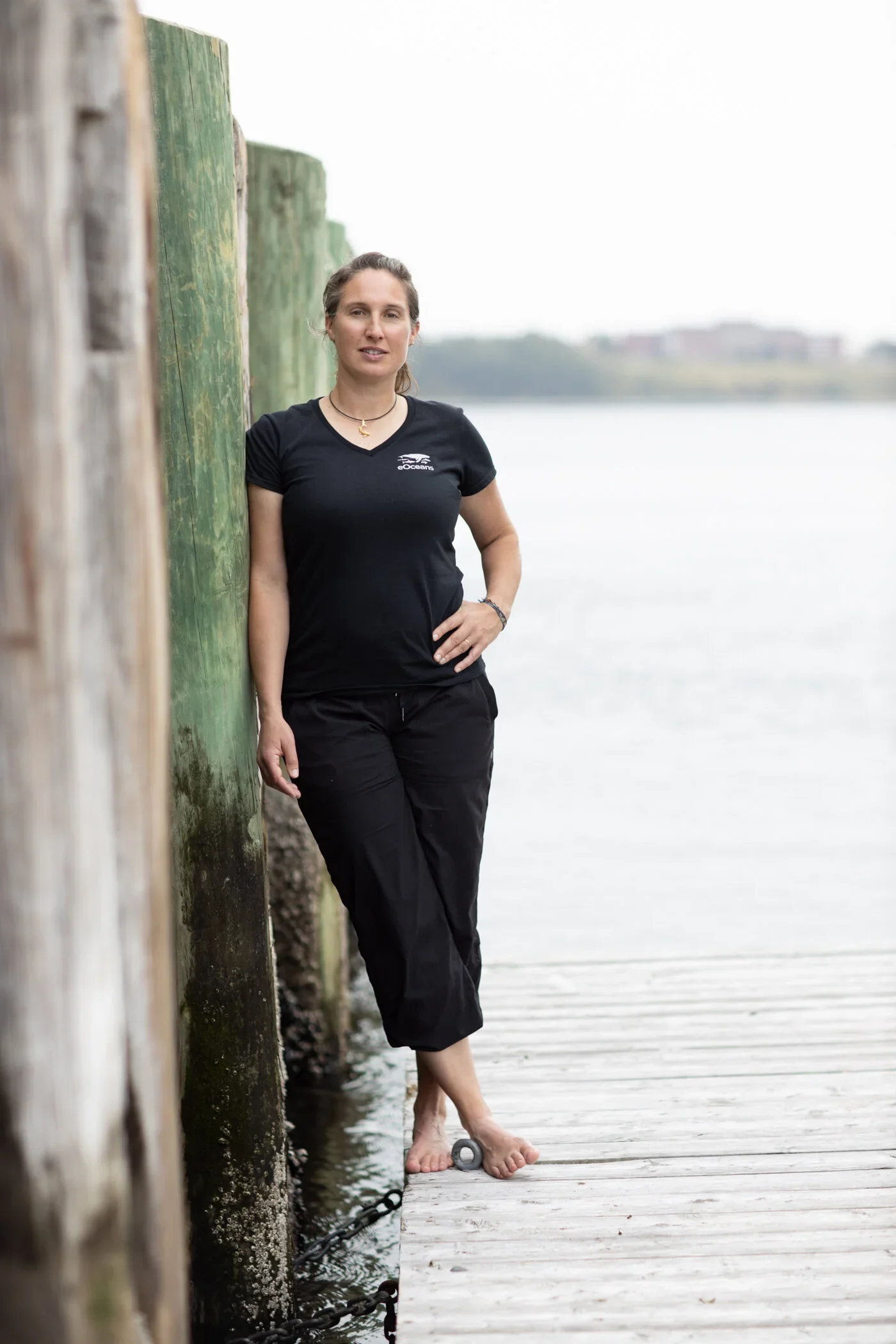
Christine Ward-Paige is the founder and CEO of eOceans, a Canadian research and technology company building tools to automate parts of ocean data science and monitoring. After more than 20 years as a scientist, Christine moved into entrepreneurship after repeatedly seeing how much time and money were spent rebuilding similar research and analysis processes. In this profile, Christine shares what it takes to move between science, technology, and business, and what they have learned about invention, pitching, mentorship, and building solutions.
Profile snapshot
- Role: Founder and CEO, eOceans
- Organisation type: Private company
- Country / region: Canada / North America
- Role type: Founder / entrepreneur; CEO / executive leader
- Topics: Technology; Data; Monitoring
Jump to
Your current role
What is your current role, and what kind of organization do you work for?
I am the Founder and CEO at eOceans, a private Canadian research and technology company. eOceans grew out of my research and consulting work and is now a global technology company building tools that automate much of the data science and monitoring workflow, so more people can answer important questions about what is happening in the world and how we can make it better.
What does a typical week look like?
It's cramped!
I have two kids that I need to get to and from school, so I have about five hours in the middle of the day to get everything done. The days often stretch into evenings and weekends. I wish I could say there is a clean separation between “work” and “life” — but, honestly, it’s all blended together.
During the day, I wear a lot of hats. I might be designing and testing something in the app, evaluating a new workflow we could improve, deciding whether a customer request represents a big enough problem for us to invest in solving, or working with our team on R&D.
And then there is everything else: bookkeeping, payroll, marketing, social media, responding to errors, making instructional videos and onboarding materials, reviewing new science and protocols to make sure we're delivering current and credible solutions, applying for RFPs, and figuring out how we're going to grow.
One of my favourite — and most nerve-wracking — things is giving demos and pitches. I can be talking to a researcher, a government department, or a large development company, and I'm always both excited and nervous. I'm hoping they'll be open about the problem they're trying to solve, what they've already tried, and what isn't working. If they don't share much about their current status and workflows, it is really hard to understand what they actually need, and then even a great demo can miss the mark.
What skills do you use most often in your role, including any technical, practical, or soft skills?
I suppose the biggest one is research — but probably not in the way people traditionally think about research. Especially as a scientist.
I need to constantly figure things out. I went from being a scientist to needing to understand enough about finance to be a CFO, technology to be a CTO, sales, marketing, product design, team management, and business strategy.
I spent 20 years working in government, academia and industry, where projects could take years and there was often an expectation that everything would be slow and ‘take the time it takes’. Now I have deadlines, customers, employees and an enormous number of things happening at once.
So I'm constantly learning.
The internet has been an incredible resource for that. There are so many people who have shared their knowledge and “how to” guides that I've been able to teach myself things I never imagined I'd need to know.
Every job has a best part and a worst part. What are they for you?
The business and finance side was probably the most intimidating at first — so it was the worst. People in business have a way of making things sound incredibly complicated! But once I got into it, I realized that it really wasn't any more difficult than the models and analyses I was doing as a scientist.
The best thing is that I still get to think like a scientist, but I have to communicate like a business person.
That has been one of the hardest transitions for me.
As a scientist, my “why” was always very big: the world is changing rapidly, and we need better evidence to get the right policies, investments, decisions and actions in place quickly enough. I thought “We urgently need eOceans to help save the world”.
But that isn't necessarily our customer's “why.”
Our customers might simply need to get more done with the people and resources they have. They might need to save time, reduce costs, win more projects, attract investment, or demonstrate impact.
Learning to understand that difference — and change the story without changing the underlying purpose — has been a huge part of becoming a founder.
What is one task you do all the time that never appears in job descriptions for these types of roles?
Inventing.
It is a task because you need to block time specifically for this task.
I knew from the beginning that I was going to invent a new system.
When I left my job, I wanted to build something that scientists, consultants, industry, governments, academics and NGOs could use to massively increase their capacity, efficiency and effectiveness — essentially, to continuously deliver more results with the capacity they already have.
My first focus was Marine Protected Areas (MPAs). Protected area managers urgently needed to be able to demonstrate whether their protection strategies were working, but evaluation was so expensive and required so many experts and time that most protected areas were never evaluated. And those that were, might only be evaluated every ten years. One evaluation I worked on had a budget of $700k over three years.
It takes too long and costs too much.
So, I knew I wanted to invent something better — that’s where eOceans started.
And I'm still inventing — every day.
Now it's new features, workflows, engagement tools, onboarding experiences, stories and ways of helping people use their data. I'm constantly listening for signals about where the need is and what eOceans could help with next.
I think that's one of the things that keeps me interested — I'm never really finished inventing.
What does this job demand of your schedule or lifestyle?
Pretty much everything!
I get texts and emails in the middle of the night. I meet with people on the other side of the world during their working hours — when everyone is asleep here. There have been meetings over Christmas holidays and during family vacations, sometimes where I have no internet connection and I’d need to drive to find access. I once borrowed a house across the street from my kids’ school so I could take a meeting during my kids’ Christmas recital.
The issues people are working on and the problems they're using eOceans to solve don't necessarily wait for me to be rested or have a day off.
I'm very committed to our customers and the challenges they're facing. That said, I do try to ask whether something is genuinely urgent and whether it can wait until the next working day. I'm learning that not everything needs to be solved immediately.
Who else do you work with or depend on to get your job done?
My CTO. I couldn't do it without him.
I'll design a feature, describe a problem I've seen in a workflow, talk to customers and users, and start thinking through possible solutions. He brings his own ideas, pushes back when I'm proposing something unnecessary or something that takes us away from our critical path, and then turns the ideas we agree on into something that actually works.
That partnership is incredibly important. I can see the problems and opportunities from the scientific, user and business sides, but I need someone who can turn those ideas into reliable technology that our customers can actually use.
Your route into this work
How did you get into this work, and were there any key opportunities, decisions, or turning points along the way?
I was a scientist for more than 20 years.
For the first 15 or so, I was primarily a field ecologist, collecting data on everything from seagrass — including literally clipping seagrass for eight hours a day to simulate green turtle feeding — to sea urchin behaviour and movement, coral diversity, sewage impacts in the Florida Keys, fisheries, carbon modelling and protected-area effectiveness.
After about ten years in the field, I shifted toward more of an “armchair ecologist” role and joined the Ransom Myers lab, which brought together fisheries and marine animal data from around the world to look for large-scale trends and patterns.
I focused on sharks and rays, much of it using observations from divers, and wrote a number of papers, including the study estimating that around 100 million sharks were being killed each year. I also led a global manta ray study using crowdsourced observations, which revealed a major gap between reported manta catches and what was actually being caught and sold around the world. That evidence contributed to their protection.
Later, I led the science for the Great Fiji Shark Count, where divers recorded around 146,000 shark observations across nearly 700 sites. I analysed those data for trends that could inform policy.
And a lot of other projects.
Throughout all of this, I kept seeing the same problem: we were spending enormous amounts of time and money answering the same questions over and over, rewriting the same lines of R code that have been written over and over, and by the time we had the answers, they were already out of date.
The return on all that effort was not good enough.
I realized we needed to do this differently. We needed to make it possible to continuously gather, analyse and use evidence without rebuilding the entire process every time. My goal wasn't simply to make my science faster. It was to help everyone get more results from the time, money, expertise and data they already have.
When my daughter was born, I decided I didn't want her to ever hear me say that I had an idea but was too afraid to pursue it.
So I went all in.
What education, training, or experience helped you get into this role?
That's a tricky question because I don't think there was one particular qualification that prepared me for becoming a CEO.
I actually had a hard time in academia. I loved it but I didn't have great mentorship, so I had to figure out a lot of things for myself and find my own path. Dr. Ransom Myers was an incredible mentor, but we lost him only two years into my PhD.
I wandered a bit after that.
What helped most was learning to listen, observe and think about problems from different perspectives.
I didn't fit particularly well into the traditional academic environment. I loved going to lectures, brainstorming, moving quickly and thinking about how to turn ideas into action. I felt a lot of pressure because the ocean and ecosystems were changing so quickly, while the culture around me often assumed we had unlimited time.
People would tell me, “Christine, slow down.”
It wasn't that I wanted to rush the science. I wanted results and impact.
Then I had my first child, and it became much harder to sit down and spend hours writing R code and processing data. That's when the idea of automating much of that work really came to the forefront.
I suspect a lot of new-parent academics have had a similar realization!
The idea grew from there.
What is one opportunity you almost didn’t apply for, but are glad you did, and why?
A pitch competition at the old Volta Labs.
At the time, it wasn't all about AI. It was about building valuable technology that solved real problems. The idea of giving a three-to-five-minute pitch was completely foreign to me.
I'd only ever given or watched 15-minute academic talks and one- to three-hour university lectures!
My first pitch competition was on a big, bright stage in a dark room, with people in suits and drinks and food everywhere. It was a very novel environment for me.
I won.
They put me on the cover of their magazine and gave me workspace alongside other startup companies. More importantly, it gave me a confidence I hadn't experienced before.
It was life-changing because I suddenly thought:
“I've got this.”
Is there any education, training, or experience you wish you had done/gotten?
Business and marketing.
If I'd learned those things before my Master's and PhD, I think many stages of my research career — and the impact of the research itself — could have been much more successful.
Marketing is really about storytelling: understanding what matters to your audience and communicating it in a way they can understand and get behind. Science needs much more of that, but for some reason scientists are often suspicious of marketing.
I think that needs to change, and quickly. Just look at public understanding, funding, trust and acceptance of science.
I also wish I'd learned more about business earlier.
Scientists and expert practitioners are incredibly good at identifying problems. We go to conferences where the main programme is often about everything that is wrong with the world, while the startups pitching solutions are tucked away somewhere in the basement.
Imagine if more of the experts were building the solutions and attracting the investment to make them happen.
Is there anything people think they need for this career that may not actually be essential?
If you're interested in science or policy, you'll often hear that you need to learn R, GIS and advanced quantitative skills.
I hope eOceans helps change that.
You absolutely still need to understand statistics, evidence and modelling. But I don't think it is a good use of people's time, careers or research budgets to spend their lives writing and debugging code or manually producing GIS maps when technology can increasingly do that work for them.
I'd encourage people to learn how to ask good questions, understand evidence, recognize uncertainty, listen to different perspectives and solve problems.
The technical tools should increasingly make those skills more accessible, rather than acting as a barrier to entry.
Reflections and advice
What advice would you give someone interested in this kind of work, and where should they look for their first step?
Get many good mentors — and don't limit yourself to your supervisor.
Find people in your department, other departments, other universities, government, and industry.
Different people will see different possibilities for you. I think I would have found my path much sooner if I'd had a broader network of people helping me think about what was possible.
If you could go back in time would you do anything differently? If so, what would that be?
I would have gotten involved in more problem-solving communities much earlier.
Don't just surround yourself with people who identify problems. Find people who want to solve them.
Scientists are incredibly good at telling you what's wrong with the world. We need that. But I wish I'd learned earlier that I also needed to surround myself with people who were excited about figuring out what to do next.
It's much more fun — and much more uplifting.
Where do you see this field heading, and what opportunities does that create for newcomers?
I think our definition of success in science is going to have to change.
For too long, scientific success has been measured largely by the number of papers someone publishes and the impact of the journal. That system is already becoming less relevant, rapidly — although many institutions still seem to be holding onto it in the way they compensate and recognize their researchers. Perhaps because they haven't figured out what should replace it?
I think the valuable skills of the future will increasingly be listening carefully, gathering and connecting evidence, bringing people together, and asking difficult questions at both local and global scales.
As AI becomes better at producing analyses and answers, our value will increasingly come from asking better questions, knowing what evidence matters, understanding context, and bringing together perspectives and information that an AI system couldn't generate on its own.
At eOceans, we're thinking deeply about these new measures of success and linking them directly in the platform: the number of cross-sector, cross-organizational and cross-border collaborations; public interest; measured environmental, social and economic outcomes; and legacy impacts — where the work being done today continues to be measured, built upon and generates value through network effects long after the original project is completed.
That's very different from today where a static paper that is published once can quickly become out of date and the citations drop off.
I think the opportunity for newcomers is enormous. You don't necessarily need to become the world's best programmer or data analyst anymore. You need to understand problems deeply, know how to gather good evidence, work with people who see things differently, and learn how to turn that knowledge into something useful.
Is there anything else you’d like to say?
I didn't leave science because I was frustrated with science. I left because I was frustrated by how slowly we were turning what we knew into action.