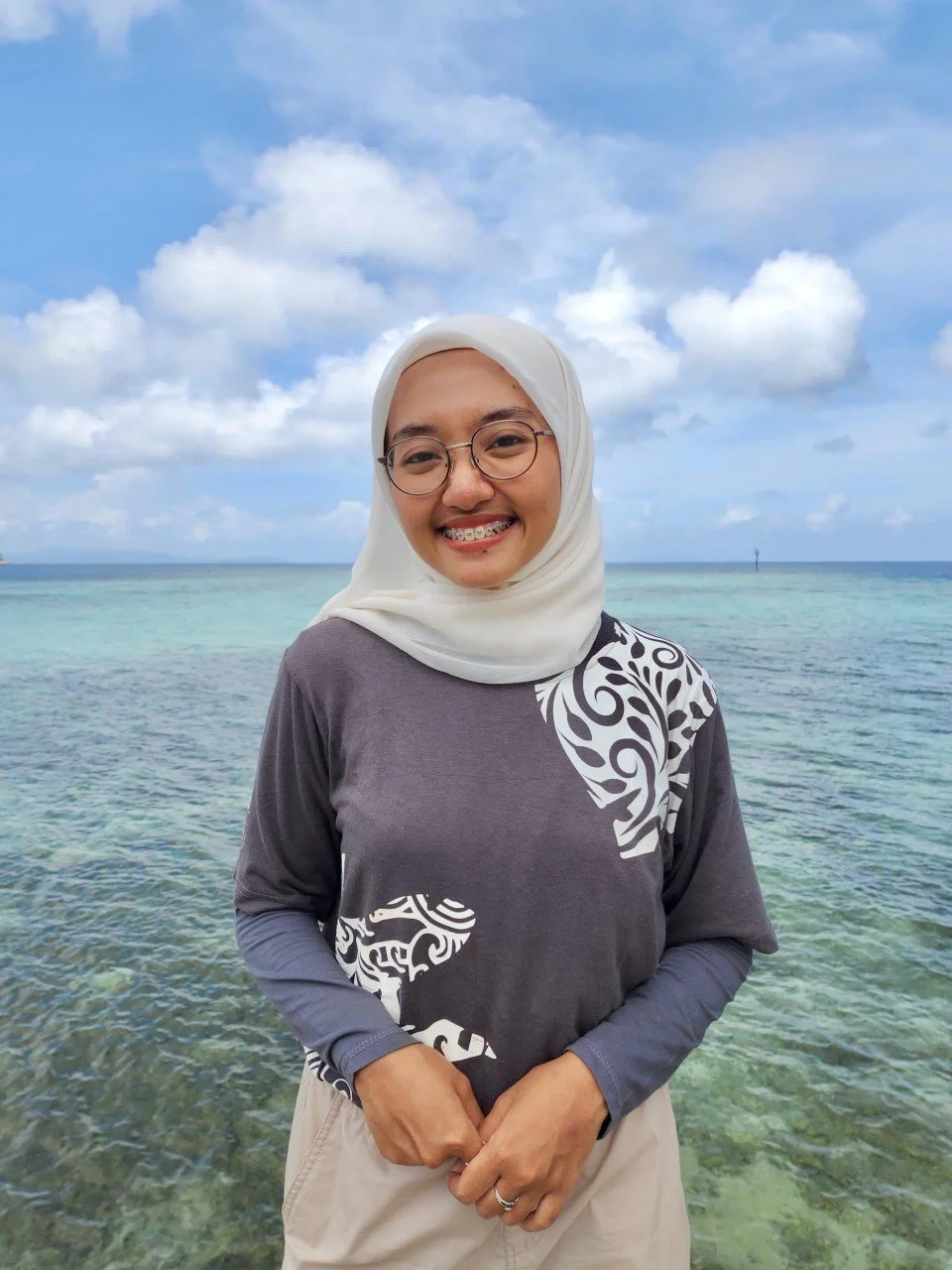
Afifa Nafisa Windiyana works in the Marine Conservation Program at Anambas Foundation, an Indonesian NGO, where they lead a project empowering local young people to take part in marine conservation. Their work combines community engagement, project management, science communication, reef monitoring, and ecosystem restoration while living and working in the Anambas Islands. For readers interested in community-based conservation, Afifa’s story gives a practical look at how a marine science background can develop into a role centred as much on people as on field science.
Profile snapshot
Role: Marine Conservation Program Staff at the Anambas Foundation
Organisation type: NGO / nonprofit
Country / region: Indonesia / Asia
Role type: Project coordinator; Field practitioner
Topics: Coastal communities, Coral reefs, Restoration, Stakeholder engagement, Science communication
Jump to
Your current role
What is your current role, and what kind of organization do you work for?
I am a Marine Conservation Program Staff at Anambas Foundation, an Indonesian Non-Government Organisation that aims to improve the overall ecosystem in the Anambas, both underwater and terrestrial as well as sustainably lifting the community's welfare.
What does a typical week look like?
I work under the Marine Conservation Program and am leading the Guardians of The Anambas Seas project to empower local youth in marine conservation. Working at the intersection of strategy and science, I manage organizational capacity building, leadership roles in the local conservation organization, ensure project financial planning, and operational workflows. As an in-house conservationist, I translate complicated science material into field impact in reef health monitoring and ecosystem restoration.
I have not only developed partnerships with conservation scientists, but also a flair for understanding in administrative works with limited resources in remote areas. In the meantime, I like to search for additional external grants to support my project and advance my skills in project and grant management.
While dedicating myself to guiding the Local Heroes in two villages, I am also involved in 'Tuk Puan', a Women in Marine Conservation project designed to enhance the participation of women from fishing communities in marine conservation. By integrating an eco-conscious livelihoods approach, the initiative empowered local women to take an active role in conservation while strengthening their economic resilience.
What skills do you use most often in your role, including any technical, practical, or soft skills?
People would easily call me a scientific diver and marine researcher, so scuba diving, coral restoration skills, coral identification, and marine science are the foundational skills.
Other than that, I would say the skills I always use are science communication & storytelling to integrate science and local knowledge. I work to empower and educate the local community, so transferring knowledge that is easy to understand is the most important thing. They are a coastal community with various backgrounds, such as fishermen's families, teachers, housewives, village government clerks, and wooden boat builders. Immersing myself in their social life is needed to understand how they cope with this and know their perspective on conservation.
Every job has a best part and a worst part. What are they for you?
The best part of my job is the impact I made to make other people more empowered, this makes my life more valuable. It’s not about enriching my life economically as I get paid to work on things, but it extends my knowledge as a Marine Science graduate to the most impacted community. Seeing a better change in the community is so rewarding.
The worst part is about perspective. For anyone who was born in the city where everything is provided easily and access is always open, I don’t think everyone would love to leave home and stay on a small island without a cafe, amusement park, gym, etc. Boredom is kicking in sometimes, that’s why being creative and adaptive is a must. Immersing myself in local daily life is how I can explore new things, so it’s not that bad. It opens to new experiences. Everything is a perspective.
Living on a small island means I have very limited access to many things and a small social interaction. However, I have many opportunities to be the representative of marine conservationists in Anambas Islands, because this area is still understudied and less explored. Chances are open widely to me especially at my early career age. I am so lucky to get flexible paid days off the island for weeks. On my days off, I get to experience an international fellowship in Hawai’i, California, Washington DC, and Thailand or advance my skills by taking a freediving and coral restoration course in Bali. I came back on site with fresh ideas and mentally prepared for new explorations.
What is one task you do all the time that never appears in job descriptions for these types of roles?
Community Engagement. I was hired as a Marine Biologist, so I thought my work was specialized in marine research and conservation. I never regret joining my team because this role gives my life meaning.
What does this job demand of your schedule or lifestyle?
- Full-time in-house conservationist living in a village, not in a remote luxury resort
- Ability to island-hop and travel
Who else do you work with or depend on to get your job done?
My team is in collaboration with The Ministry of Fisheries and Marine Affairs. We have a MoU with them to report data and integrate both programs in Anambas Islands.
Your route into this work
How did you get into this work, and were there any key opportunities, decisions, or turning points along the way?
I was notified about this job when I was in the middle of finishing a Coral Catch Scholarship, a coral restoration scholarship program that encourages and empowers local women to have a career in marine conservation. I never knew the exact location of the Anambas Islands but my fellow scholars who worked in Anambas years ago said to me, “It’s your time to dedicate yourself”. I thought it’s a calling. In brief, I applied for the role, had an interview, and got it—without ever doubting myself on my first full time job.
What education, training, or experience helped you get into this role?
Marine Science, Coral Identification, Coral Restoration, and Scientific Diving.
Reflections and advice
What advice would you give someone interested in this kind of work, and where should they look for their first step?
Get yourself a scuba diving license (if you haven’t); it’s the very first step to understanding your role in the marine environment and having chemistry with the ocean. Then, travel the world because sometimes ideas come from the most insane trip or the people you meet accidentally.
If you could go back in time, would you do anything differently?
No, I am so grateful for my life and job right now, but if I could add another experience, I would want to deepen my knowledge of research methods, so that when I am ready with community engagement, I can involve them in some steps if required.
Is there anything else you’d like to say?
My dream is to sustain marine conservation efforts by improving local community participation and to do more research in marine protected area studies. If you would like to know more about my work or are interested in collaboration, please don’t hesitate to reach out to me!