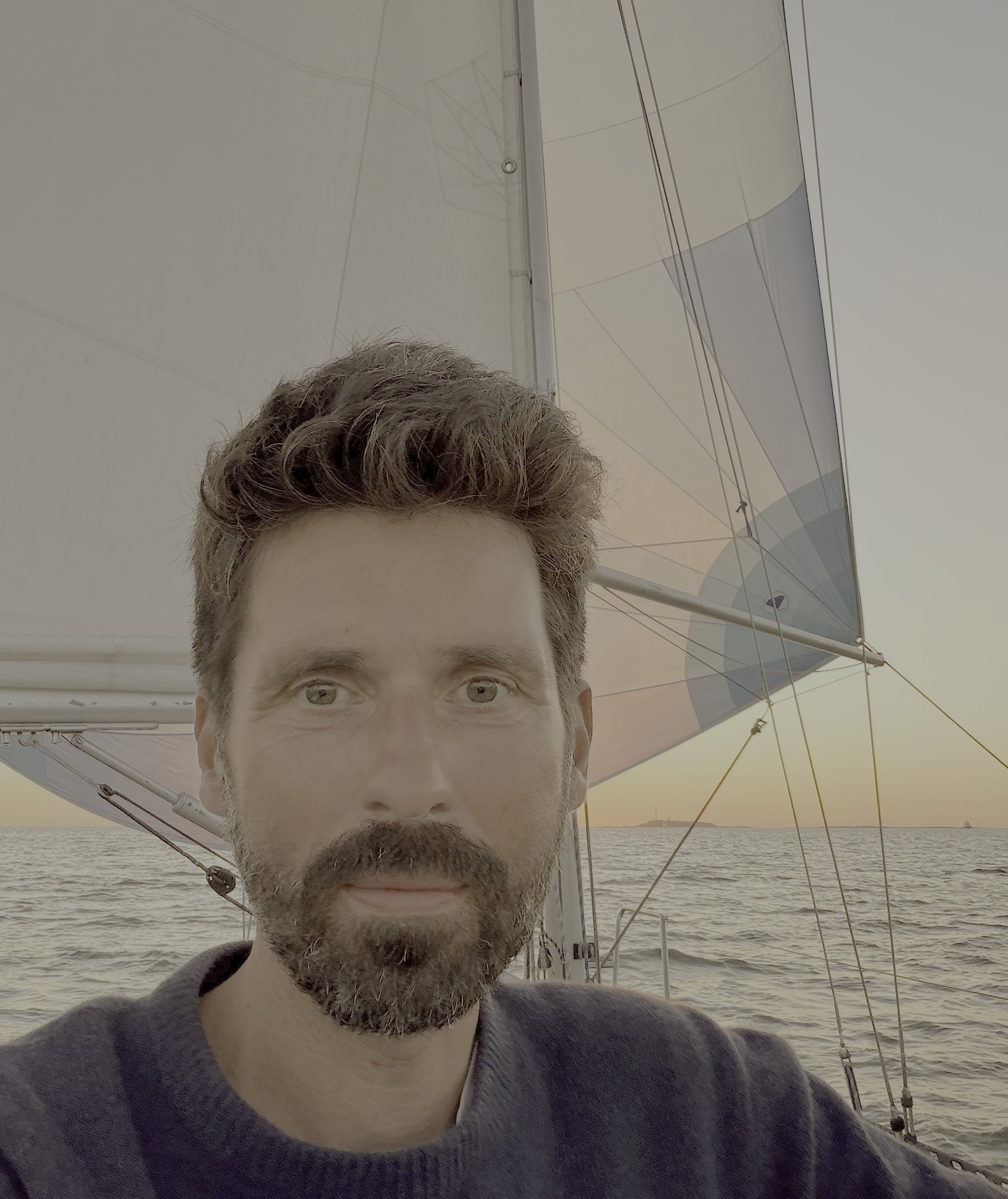
Klas Ove Möller is a biological oceanographer, senior scientist and Head of the Department of Biological Carbon Pump and Plankton at the Helmholtz-Zentrum Hereon in Germany. His work spans plankton ecology, biological oceanography and ocean observation, increasingly bringing together imaging, sensors, autonomous systems, marine robotics, artificial intelligence and large-scale research coordination. Klas’s profile offers an example of how a scientific career can evolve from specialist research into interdisciplinary leadership, strategy and international collaboration.
Profile snapshot
Role: Biological Oceanographer, Senior Scientist and Head of the Department of Biological Carbon Pump and Plankton
Organisation type: Research institute
Country / region: Germany / Europe
Role type: Researcher; Director / senior leader
Focus areas: Research; Technology; Data; Monitoring; Modelling; Biodiversity; Science communication; Plankton
Jump to
Your current role
What is your current role and what kind of organisation do you work for?
I am a biological oceanographer, senior scientist and Head of the Department “Biological Carbon Pump and Plankton” at the Helmholtz-Zentrum Hereon in Germany, a publicly funded research centre and part of the Helmholtz Association. My scientific roots are in plankton ecology, biological oceanography and underwater imaging, but today a central question in my work is broader: How can we improve the way we observe the ocean, and turn those observations into useful knowledge?
My work ranges from fundamental research on plankton, biodiversity and the biological carbon pump to new approaches for ocean observation, including imaging, sensors, autonomous systems, marine robotics and artificial intelligence. I co-coordinate the “MUSE” marine robotics infrastructure and the Foundation Model initiative “AqQua”, two large cross-centre Helmholtz initiatives that bring together these different areas. A substantial part of my role is therefore not only doing science, but connecting people and expertise across disciplines and research centres.
There is also a strategic side. Nationally and internationally, I contribute to discussions about what we need to observe, where the gaps are, and how observations, data and models can better serve science and society. This includes the UN Decade of Ocean Science, where I’m a member of the Scientific Steering Committee of JETZON – the Joint Exploration of the Twilight Zone Ocean Network.
I am particularly interested in extending ocean observation beyond dedicated research vessels. Autonomous platforms, commercial ships, sailing vessels and other non-research platforms can help us observe much more of the ocean. This is also where work and personal interests meet: I am a passionate sailor, and collaborations with The Ocean Race, Team Malizia and the Malizia Explorer have connected sailing with ocean observation, citizen science and communication.
The common motivation behind all of this is simple: I want my work to contribute to changing something for the better.
What does a typical week look like?
There isn’t really a typical week, which is probably one of the reasons I still enjoy the job.
A week can include discussions with my research group about scientific results or instruments, proposals and project strategies, conversations with engineers about robotics, discussions with data scientists about AI, project coordination, reviewing papers, presentations, and meetings with funding agencies, industry partners, policy makers or other stakeholders. Communication and outreach have also become an increasingly important part of my work.
Then there are weeks at sea, workshops, conferences and international meetings, and occasionally the opportunity to sit down and actually analyse data or think about a scientific problem—which tends to become rarer as you move into more senior and coordinating roles.
My calendar probably makes the job look as if I spend my life in online meetings. Fortunately, every now and then I am reminded that my actual workplace is the ocean.
What skills do you use most often in your role, including any technical, practical, or soft skills?
Curiosity is probably the most important one.
In my current role, many of the skills I use most often are not particularly technical. Communication, coordination, writing, listening, negotiating and strategic thinking are at least as important. Large ocean projects are inherently interdisciplinary: a biologist, an engineer, a physical oceanographer and an AI researcher may all be talking about the same ocean, but they do not necessarily speak the same scientific language. Add industry, funding organisations, policy makers or sailors, and the perspectives become even more diverse.
A surprisingly important part of my job is therefore translating between these worlds—understanding what motivates different people and finding a common question or goal.
And then there is improvisation. Ocean research teaches you that things rarely happen exactly as planned. Instruments fail, weather changes, ships are delayed, budgets change and opportunities suddenly appear. You have to adapt without losing sight of the bigger goal.
Every job has a best part and a worst part. What are they for you?
The best part is the variety and the people. Ocean science is incredibly international and collaborative. I have had the opportunity to work with people from many countries and disciplines, spend time at research institutions abroad, go to sea, work with new technologies and help turn ideas into larger collaborative projects.
I particularly enjoy the moment when people from quite different communities realise that they can solve a problem together. And despite all the meetings and administration, there are still moments when you see something in the ocean that nobody has seen in quite that way before. That feeling never really gets old.
The worst part is probably the amount of bureaucracy involved in modern science. Research funding, procurement, reporting and administration can consume an astonishing amount of time.
What does this job demand of your schedule or lifestyle?
Travel is certainly part of it. Ocean science involves research cruises, conferences, project meetings, workshops and international collaborations. Earlier in my career I spent more time travelling and at sea; today there is more coordination, strategy and international meeting time.
Fieldwork has its own rhythm. A research cruise does not care very much whether it is Saturday, Sunday or 3 a.m. If ship time is limited and the weather gives you a chance to deploy an instrument, you do it. Fortunately, most of the time it is also exciting and fun.
International coordination has a different challenge: someone is almost always awake somewhere in the world and would be perfectly happy to schedule a meeting with you.
Who else do you work with or depend on to get your job done?
Almost everyone!
Within ocean science, I work with biologists, biogeochemists, physical oceanographers, modellers and data scientists. Because we develop and use new observing technologies, engineers, technicians, software developers, roboticists and AI researchers are equally important.
For larger programmes I also work with research infrastructure operators, funding agencies, governmental organisations, companies, NGOs and policy makers, as well as people who would not traditionally be considered part of the scientific ocean-observing community—for example sailors, commercial vessel operators and citizen scientists.
Modern ocean research cannot be done by a single discipline, and many of the most interesting questions sit somewhere between them.
Your route into this work
How did you get into this work, and were there any key opportunities, decisions, or turning points along the way?
My route was not based on a carefully designed career plan. I studied biological oceanography at the University of Hamburg and became fascinated by plankton—tiny organisms that are extremely important for marine food webs and the global carbon cycle, but remarkably difficult to observe in their natural environment. Early in my career I became involved in underwater imaging, which offered a very different way of looking at plankton and particles directly in the ocean rather than only in samples collected afterwards.
The field was small and very international, and I became part of a supportive community in which people shared ideas and experience, organised workshops, visited each other and solved problems together. That experience shaped how I think about science: collaboration and openness can move a field forward much faster than working in isolation.
The technology also broadened my scientific interests. I became increasingly interested not only in the biological questions, but in how we observe the ocean. From there my work expanded towards integrated ocean observation, autonomous systems and robotics, new sensors, large datasets and artificial intelligence.
After my Master’s degree, I stayed at the University of Hamburg for my PhD in biological oceanography and later continued there as a researcher. In 2016 I moved to what is now the Helmholtz-Zentrum Hereon, and in 2019 became head of the research group that is now the Department of Biological Carbon Pump and Plankton.
Over time, my focus also shifted from concentrating mainly on my own scientific questions towards coordinating larger projects, developing strategies and working across disciplinary and institutional boundaries. I do not see that as moving away from science. For me, it has been an expansion of what being a scientist can involve.
Looking back, the route appears much more logical than it felt while I was taking it.
What education, training, or experience helped you get into this role?
I studied biological oceanography at the University of Hamburg, completing my Master’s degree in 2007 and my PhD in 2013.
The formal education was important, but some of the most valuable training happened through being involved in real research from quite early on. We were a relatively small group of students, which meant opportunities to join research projects, go to sea, work with instruments and deal with imperfect real-world data rather than only textbook examples.
Research visits and collaborations with colleagues from different disciplines and countries were equally valuable. I also learned a great deal simply by doing things for which I was not completely prepared. Writing your first proposal, giving talks, supervising people, managing budgets, developing strategies or leading a consortium are all things you can learn about in courses, but at some point you have to actually do them.
And none of this happens alone. Having supportive colleagues, mentors and a working environment that gives you room to try things—and occasionally get them wrong—makes an enormous difference.
Is there any education, training, or experience you wish you had done/gotten?
Probably more formal training in management, strategy and leadership earlier in my career. Scientists are trained very thoroughly to do science, but becoming a senior scientist can suddenly mean managing people, budgets, conflicts, projects and organisations—often without anyone having had a serious discussion with you about what good leadership actually means.
I would also have liked to develop deeper programming and data-science skills earlier. I taught myself quite a lot along the way, but these skills have become increasingly central as ocean observing systems produce ever larger and more complex datasets.
Is there anything people think they need for this career that may not actually be essential?
A perfectly planned CV.
There is a tendency to look at established scientists and imagine that their careers followed a straight line: degree, PhD, postdoc, permanent position, leadership. In reality, careers are usually much messier. You also do not need to know exactly what scientific topic you want to work on for the next 30 years. Methods change, technologies change, your interests change and entirely new research fields emerge.
What matters more is curiosity, willingness to learn, resilience when something does not work, and the ability to work with other people.
And don’t assume that interests outside your formal scientific training are irrelevant. Sailing was simply something I enjoyed; today it connects naturally to my work on ocean observation, citizen science and communication. The same could be true for programming, engineering, diving, photography, design or many other interests. Sometimes the unusual combination of things you know and enjoy is exactly what makes your contribution valuable.
Reflections and advice
What advice would you give someone interested in this kind of work, and where should they look for their first step?
Get involved as early as you can and do not worry too much about finding the “perfect” first step.
Look for student assistant positions, internships, Master’s projects, summer schools, research cruises or opportunities to help with fieldwork. Contact researchers whose work genuinely interests you. Most scientists are quite happy to hear from someone who has actually read about their research and has a specific reason for getting in touch.
Build relationships, but do not think of networking simply as asking, “Who might be useful for my career?” A good scientific network is about exchange: sharing experience, helping somebody solve a problem, introducing people who should know each other and contributing when somebody else needs help.
Learn practical things as well. Knowing how to analyse data, write some code, operate an instrument, make a clear figure, communicate an idea—or fix something that has stopped working on a ship—can be enormously valuable.
And don’t underestimate soft skills. Science is collaborative. Being reliable, curious, open, generous with ideas and pleasant to work with will take you surprisingly far.
What is one mistake, challenge, or lesson from early in your career that taught you something useful?
Probably learning that not everything has to be perfect before you show it to somebody. Scientists are trained to be critical, and that can easily become perfectionism. You can spend a great deal of time improving the final few percent of something when discussing the unfinished idea with another person would have moved it forward much faster.
I have increasingly learned the value of sharing ideas early, asking for help and building things collaboratively.
And perhaps another lesson: instruments will fail. Usually when the ship is already at sea. Always bring enough spare parts.
Have a Plan B.
Preferably also a Plan C.
Where do you see this field heading, and what opportunities does that create for newcomers?
Ocean observation is going through a major transformation. Research vessels will remain essential, but they are expensive, limited in number and can only be in one place at a time. If we want to understand a rapidly changing ocean, we need much better coverage in space and time. That means a more integrated and distributed observing system: research vessels combined with autonomous vehicles and robots, satellites, underwater observatories, commercial ships, sailing vessels and other platforms. We also need to become smarter about what, where and when we observe. The goal is not simply to collect more data, but to combine observations to increase our knowledge.
Robotics, autonomous systems and artificial intelligence create enormous possibilities here. Systems can operate for longer periods and increasingly respond to what they observe, while AI can help us extract information from amounts and types of data that would be impossible to analyse manually. Another important development is the use of digital twins, which bring observations and models together into dynamic representations of complex systems such as the ocean. Beyond research, they can help us explore scenarios, communicate complex processes and support education, outreach and decision-making. But a digital twin is only as good as the observations and models behind it—which brings us straight back to the need for better ocean observation.
I am also interested in looking beyond the traditional research community. Through collaborations with The Ocean Race, Team Malizia and the Malizia Explorer, for example, we are exploring how platforms already travelling across the ocean can contribute scientifically useful observations. I like the change in perspective: instead of asking only, “Where can we send a research ship?”, we can also ask, “Who is already out there, and how can we work together?”
This creates opportunities for newcomers with very different backgrounds. We need marine biologists and oceanographers, but also engineers, roboticists, sailors and mariners, software developers, AI specialists, data scientists, modellers, communicators, designers and people who understand industry, policy and society. I think many of the most interesting opportunities will emerge in exactly this interdisciplinary space.
Is there anything else you’d like to say?
When I started studying biological oceanography, I certainly did not imagine that plankton research would eventually lead me into autonomous ocean observation, robotics, artificial intelligence, strategy, citizen science, sailing and collaborations across science, industry and society. Most of those steps were not part of a plan; they grew out of questions, people and opportunities along the way.
What has remained constant is the motivation to use science to contribute to positive change. Science gives us knowledge and evidence, but turning that knowledge into action requires communication and collaboration well beyond the scientific community. That is probably where I see my own role today: still a scientist, but also someone trying to connect different worlds.
So if you are interested in the ocean but cannot immediately see where you fit, don’t assume that means there isn’t a place for you. Ocean science needs specialists, but it also needs people who connect disciplines, technologies, communities and ideas.
And occasionally you still get to go to sea, deploy an instrument and discover something unexpected. That remains difficult to beat.