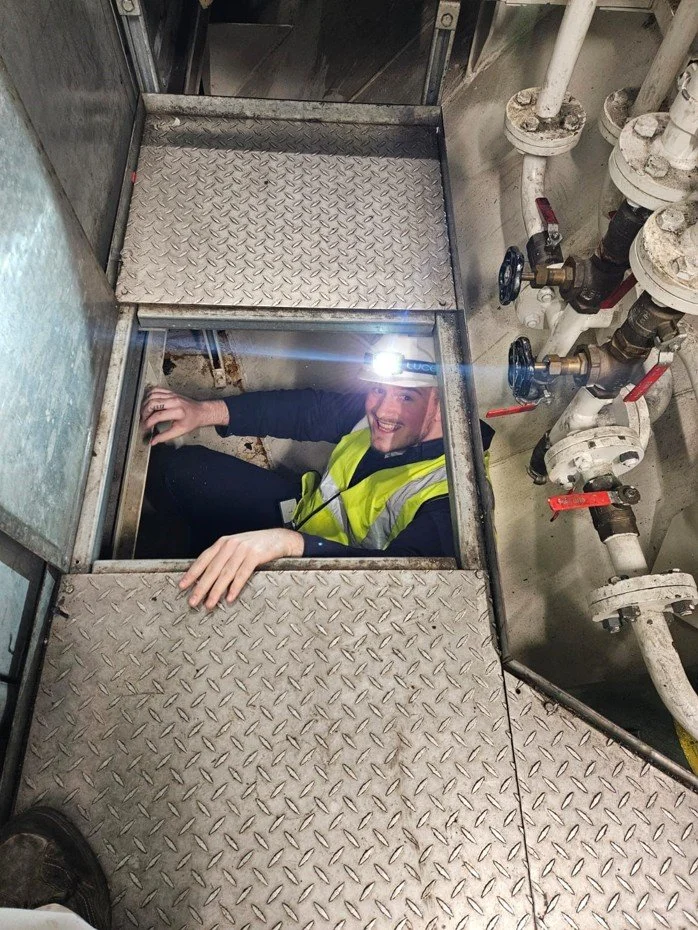
Jordan Tyers is a Marine Engineer at BMT, an independent maritime engineering consultancy, working across defence and commercial shipping projects. Their role combines 2D and 3D design, engineering calculations, technical writing and vessel surveys, alongside a part-time engineering degree. Jordan’s route from apprenticeship to engineer gives readers a useful example of entering marine engineering without following a traditional full-time university pathway.
Profile snapshot
Role: Marine Engineer at BMT
Organisation type: Private company
Country / region: UK / Europe
Role type: Engineer
Topics: Engineering, Maritime industry, Technology
Jump to
Your current role
What is your current role and what kind of organization do you work for?
I am a Marine Engineer at BMT, an independent maritime engineering consultancy business. My work is mainly within marine engineering, supporting both defence and commercial shipping projects. I specialise in outfit and arrangement design (O&A), which is about making sure equipment, systems and people can fit and operate safely and effectively within a ship.
My role can cover everything from developing early layout concepts to producing detailed drawings, system diagrams, calculations and installation guidance for changes to existing vessels.
What does a typical week look like?
There is no completely typical week, which is one of the things I enjoy about the job. Most weeks involve a mixture of 2D drawing, 3D modelling, engineering calculations, technical writing and meetings with other disciplines or customers.
I might be arranging machinery within a compartment, modelling pipework from survey information, updating piping and instrumentation diagrams, or writing guidance that explains how a modification should be installed onboard. When a project requires it, I also prepare for and attend ship surveys, where I collect measurements, photographs, sketches and 3D scan data. Alongside work, I am completing a part-time engineering degree through day release, so one day each week is normally dedicated to university study.
What skills do you use most often in your role, including any technical, practical, or soft skills?
Technically, I use computer-aided design most often, particularly AutoCAD for 2D arrangements and Inventor for production drawings and 3D models. I also use surveying, 3D scanning, system design, engineering calculations and technical report writing.
Practical understanding is important because a design must work in a real ship, not just look tidy on a screen. That means considering access, work in way (equipment or structures that could obstruct work or access), maintenance, installation, pipe and cable routes, safety and the needs of ship staff.
The soft skills are just as important. Communication, teamwork, adaptability, and problem-solving skills are essential, especially when working across several engineering disciplines or explaining a design to a customer.
Every job has a best part and a worst part. What are they for you?
The best part is seeing a design progress from an initial problem or survey into something practical that could improve how a vessel operates. I also value the variety. I have worked on new ship designs, retrofit projects and surveys, and each one has taught me something different.
The most difficult part is balancing competing deadlines and, at times, balancing project work with academic study. Marine projects also involve detailed checking and documentation, which can be demanding, but that discipline is essential because the quality and safety of the final design matter.
What is one task you do all the time that never appears in job descriptions for these types of roles?
A surprising amount of time is spent finding, checking and organising information. Before designing anything, I may need to read applicable standards, compare old drawings, survey photographs, supplier data, customer comments and assumptions to build a reliable picture of the design work.
Learning from the wealth of knowledge my colleagues have was fundamental in my progression from an apprentice to an engineer. Good engineering often starts with asking sensible questions and making sure the information you are using is accurate.
What does this job demand of your schedule or lifestyle?
Most of my work is office-based and can involve flexible or hybrid working, but projects sometimes require travel to customer sites, shipyards or vessels. I have travelled within the UK and overseas for surveys, including visits to Belfast, across England, and even Canada.
Surveys can involve longer days in unfamiliar and sometimes challenging shipboard spaces, so preparation, flexibility and a practical mindset are important. My degree apprenticeship also requires me to balance four working days with one day of university study during the academic year.
Who else do you work with or depend on to get your job done?
Marine engineering is very collaborative. I work with naval architects, structural engineers, electrical engineers, systems engineers, project managers, drawing checkers, and certifiers.
I also rely on customers, ship staff, shipyards and equipment suppliers for operational knowledge, design requirements and technical information. A strong solution normally comes from bringing those different viewpoints together rather than working in isolation.
Your route into this work
How did you get into this work, and were there any key opportunities, decisions, or turning points along the way?
I joined BMT as a Naval Engineering Apprentice in September 2020. At the time I was studying A-levels in sixth form, but I decided to change my path and take the apprenticeship because the opportunity to learn on the job, gain recognised qualifications and earn a salary suited me better than a traditional full-time university route.
My older brother had completed an apprenticeship when he was my age, which helped me understand that it was a valuable route into engineering. A major turning point was specialising in outfit and arrangement work and beginning to take responsibility for real ship design deliverables.
Completing the apprenticeship, gaining Engineering Technician registration with the IMechE and moving into a Marine Engineer role were important milestones. Winning the 2024 IMarEST Lady Hamlyn Award also gave me confidence that my continued professional development was being recognised by the wider maritime profession.
What education, training, or experience helped you get into this role?
My apprenticeship combined academic study with practical project experience. I completed Level 2 Performing Engineering Operations, a Level 3 BTEC in Advanced Manufacturing Engineering, an NVQ Level 3 in Engineering Technical Support, and HNC and HND qualifications in General Engineering. I am now studying towards a BEng in Mechanical Engineering at the University of the West of England (UWE).
I am fortunate to work in a company which really drives professional development, so I have undertaken many internal training courses across multiple disciplines, and I have also had the opportunity to learn through external courses, all funded by BMT. Just as importantly, working on live projects and going onboard vessels helped turn the theory into practical understanding. I have found the most valuable knowledge gained through real project work is something you won’t learn in a classroom.
Is there any education, training, or experience you wish you had done/gotten?
Before joining BMT my only academic certificates were GCSEs, so I essentially dived straight into a field of work I had no prior knowledge of. Needless to say, I knew I had a strong passion for art, maths and design work so the pathway to engineering felt like it was always destined.
Apprentices and those early in their careers are not expected to have all this knowledge from the get-go, and this is really important to remember as you find your feet.
Is there anything people think they need for this career that may not actually be essential?
A traditional full-time university degree is not the only way into marine engineering. My route began through an apprenticeship, where I built qualifications gradually while gaining practical experience. You do not need to arrive knowing everything about ships either. Curiosity, a willingness to learn, attention to detail and the confidence to ask questions are more important at the start. Technical knowledge grows through study, guidance from experienced colleagues and exposure to real projects.
Reflections and advice
What advice would you give someone interested in this kind of work, and where should they look for their first step?
Start by exploring the different routes into engineering rather than assuming there is only one. Look at apprenticeships, degree apprenticeships, college courses, graduate schemes and entry-level roles offered by ship designers, consultancies, shipyards, equipment suppliers, the Royal Navy and the wider maritime supply chain.
Professional bodies such as IMarEST and IMechE are also useful places to learn about careers, events and development opportunities. Try to build a broad base in maths, science, design and digital tools, but do not underestimate communication and teamwork.
Most importantly, apply even if you do not meet every line of a job description. Employers expect early-career engineers to learn, and enthusiasm supported by good examples of problem-solving can go a long way.
What is one mistake, challenge, or lesson from early in your career that taught you something useful?
One of the biggest lessons was that asking questions early is much better than making assumptions and correcting them later. Ship design brings together a huge amount of information, and no junior engineer is expected to know it all.
I also learned resilience while balancing work with college study. At points during my HNC and HND, teaching disruption meant I had to take more responsibility for my own learning. It was challenging, but it showed me that progress does not always follow a perfect plan and that being organised, persistent and willing to seek support during hard times makes a real difference.
Where do you see this field heading, and what opportunities does that create for newcomers?
Marine engineering is becoming increasingly digital and integrated. Greater use of 3D modelling, scanning, data-led design, automation and autonomous systems will change how vessels are designed, surveyed, operated and maintained.
At the same time, the industry faces major challenges around sustainability, alternative fuels, energy efficiency and the renewal of naval and commercial fleets, so internally this is a big focus for myself and my colleagues. For newcomers, that creates opportunities to combine traditional engineering fundamentals with skills in digital tools, electrical systems, software, data and environmental design. The sector needs people who can work across disciplines and turn new technology into solutions that are safe, practical and suitable for life at sea.
Is there anything else you’d like to say?
The maritime industry is much broader than many people realise. You do not have to grow up around ships or have a family connection to the sea to find a place in it (I did not!).
There are routes for practical people, designers, analysts, project managers, scientists and many other specialists. My apprenticeship gave me opportunities to contribute to real projects, travel, learn from experienced engineers and continue my education without stepping away from work.
I would encourage young people and anyone considering a career change to look beyond the job titles, speak to people in the industry and see where their own interests could fit.