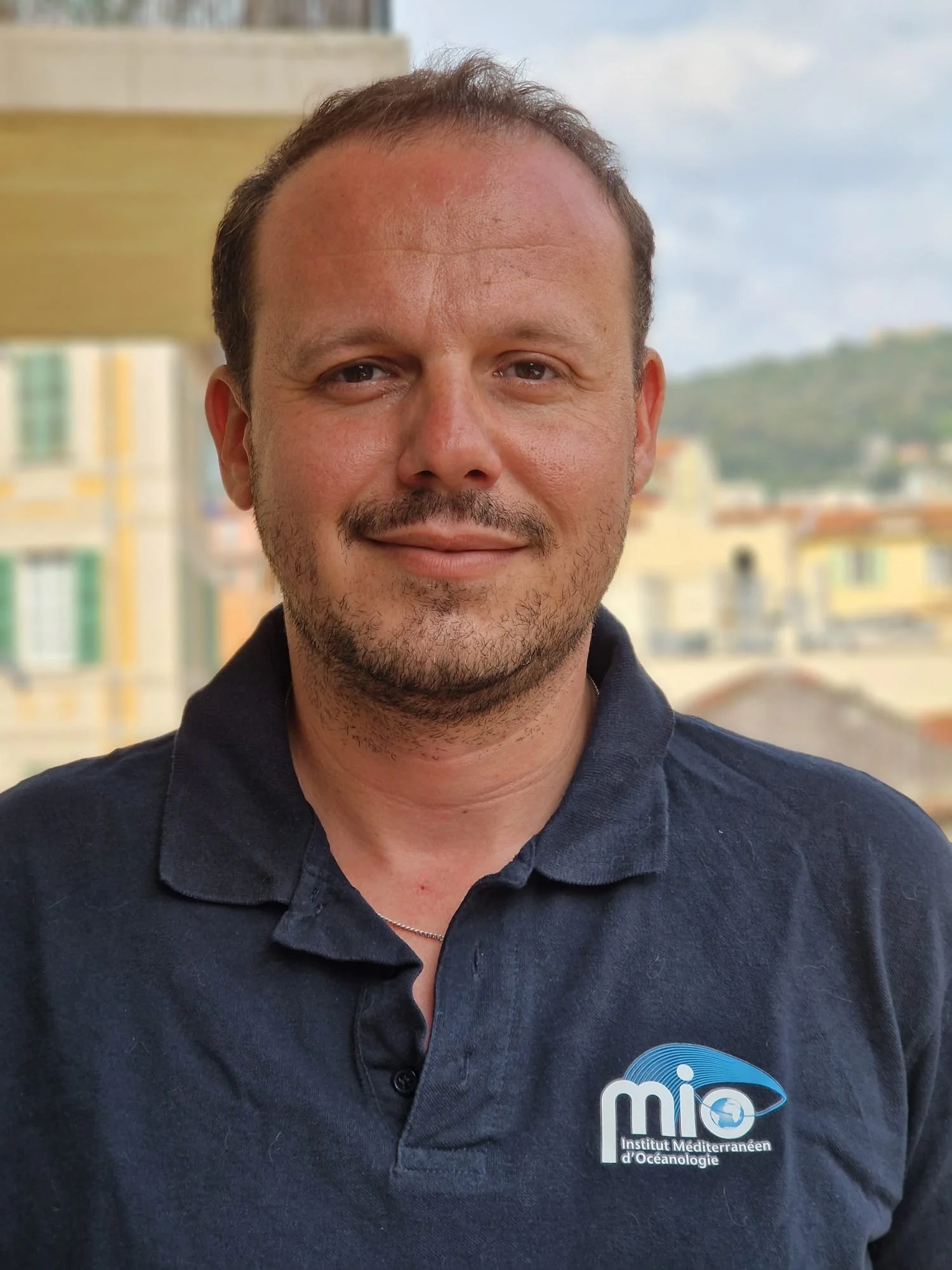
Guillaume a rédigé ce profil en français. Ses réponses originales en français sont publiées accompagnées d'une traduction en anglais.
Guillaume completed this profile in French. Their original French responses are published alongside an English translation.
Guillaume Marchessaux est Chargé de Recherche à l’IRD (Institut de Recherche pour le Développement), affecté à l’Institut Méditerranéen d’Océanologie à Marseille. Ses recherches portent sur les impacts socio-écologiques des espèces invasives marines sur les écosystèmes côtiers et lagunaires, avec un intérêt particulier pour l’application de la recherche à leur gestion et à leur régulation. Son parcours montre comment une carrière scientifique peut combiner terrain, laboratoire, analyse de données, collaboration interdisciplinaire et communication scientifique.
English
Guillaume Marchessaux is a Research Scientist at IRD (the French National Research Institute for Sustainable Development), based at the Mediterranean Institute of Oceanography in Marseille. His research focuses on the socio-ecological impacts of marine invasive species on coastal and lagoon ecosystems, with a particular interest in applying research to their management and regulation. His career shows how a scientific role can combine fieldwork, laboratory work, data analysis, interdisciplinary collaboration and science communication.
Profile snapshot
Role: Research Scientist
Organisation type: Research institute
Country / region: France / Europe
Role type: Researcher
Focus areas: Research; Oceanography; Conservation; Science communication; Invasive species
Jump to
- Votre poste actuel / Your current role
- Votre parcours vers ce métier / Your route into this work
- Réflexions et conseils / Reflections and advice
- Conecta et découvrez plus / Connect and learn more
Votre poste actuel / Your current role
Quel est votre poste actuel et pour quel type d’organisation travaillez-vous ? / What is your current role and what kind of organisation do you work for?
Français
Je suis Chargé de Recherche à l’IRD (Institut de Recherche pour le Développement), et affecté à l’Institut Méditerranéen d’Océanologie (M.I.O.) à Marseille. L’IRD est un institut de recherche qui vise à mener des recherches sur la santé humaine, la sécurité alimentaire et l’adaptation aux changements globaux, avec une priorité pour les pays en développement.
Dans mon cas je travaille sur l’impact socio-écologique des espèces invasives marines sur les écosystèmes côtiers et lagunaire. Mes recherches visent à mobiliser des outils de recherche pour les appliquer à la gestion et la régulation des espèces marines invasives pour limiter leurs impacts sur la biodiversité et les activités humaines.
English
I am a Research Scientist at IRD (the French National Research Institute for Sustainable Development), based at the Mediterranean Institute of Oceanography (M.I.O.) in Marseille. IRD is a research institute that aims to conduct research on human health, food security and adaptation to global changes, with a priority focus on developing countries.
In my case, I work on the socio-ecological impact of marine invasive species on coastal and lagoon ecosystems. My research aims to mobilise research tools and apply them to the management and regulation of invasive marine species in order to limit their impacts on biodiversity and human activities.
À quoi ressemble une semaine type ? / What does a typical week look like?
Français
Mon travail de chercheur est très varié en activités, et une journée type peut varier dans l’année. Je dirais que pendant l’hiver où les conditions ne sont pas optimales pour aller sur le terrain, je passe principalement mes journées au bureau, à analyser les données acquises dans l’année, à répondre à des appels à projets. Le reste de l’année par contre, je dois faire 1 ou 2 journées de bureau, et 3 jours de terrain ou de laboratoire. Être sur le terrain et en laboratoire est un indispensable pour moi, je travaille sur le milieu marin, donc être au plus près du milieu est particulièrement important.
English
My work as a researcher involves a wide variety of activities, and a typical day can vary throughout the year. I would say that during winter, when conditions are not optimal for going into the field, I mainly spend my days in the office, analysing the data collected during the year and responding to calls for proposals. During the rest of the year, however, I tend to spend one or two days in the office and three days doing fieldwork or laboratory work. Being in the field and in the laboratory is essential for me; I work on the marine environment, so being as close as possible to the environment is particularly important.
Quelles sont les compétences que vous utilisez le plus souvent dans le cadre de votre fonction, qu’il s’agisse de compétences techniques, pratiques ou relationnelles ? / What skills do you use most often in your role, including technical, practical or interpersonal skills?
Français
Le métier de chercheur nous oblige à être des « couteaux suisses » : on gère aussi bien des équipes, que des expérimentations en laboratoire et sur le terrain.
En tant que chercheur je collabore avec beaucoup de personnes différentes (chercheurs, postdoctorants, doctorants, et étudiants). Il est donc indispensable d’être sociable, à l’écoute et dans la pédagogie pour travailler avec ce panel de collaborateurs.
En termes de compétences techniques, je fais beaucoup de laboratoire en faisant des expériences sur des animaux marins vivants, mais aussi de l’analyse de données (statistiques, modèles, etc.), et beaucoup de bricolage aussi. On fabrique souvent nos outils ou installations, il faut aussi être manuel. Et puis il y a la rédaction en français et en anglais qui est particulièrement primordiale car nous écrivons beaucoup de rapports et articles scientifiques. Enfin il faut être bon communiquant, on fait des conférences entre scientifiques, des interventions auprès du grand public et des écoles, il faut donc être pédagogue et adaptable au public que l’on rencontre.
English
The job of a researcher requires us to be “Swiss Army knives”: we manage teams as well as experiments in the laboratory and in the field.
As a researcher, I collaborate with many different people (researchers, postdoctoral researchers, doctoral students, and students). It is therefore essential to be sociable, to listen and to have a teaching mindset in order to work with this range of collaborators.
In terms of technical skills, I do a lot of laboratory work, carrying out experiments on live marine animals, but also data analysis (statistics, models, etc.), and quite a lot of DIY as well. We often build our own tools or installations, so you also need to be practical with your hands. Then there is writing in French and English, which is particularly important because we write many reports and scientific articles. Finally, you need to be a good communicator: we give presentations to other scientists and talks to the general public and schools, so you need to be able to teach and adapt to the audience you are speaking to.
Chaque métier a ses avantages et ses inconvénients. Quels sont-ils pour vous ? / Every job has its advantages and disadvantages. What are they for you?
Français
C’est un métier où nous avons une très grande liberté et autonomie de choisir avec qui on veut travailler et sur quoi on veut travailler, et c’est un avantage. On travaille sur la nature, on est souvent sur le terrain à travailler avec des animaux marins, pour moi c’est un métier magnifique quand on est passionné comme moi.
En revanche, il y a forcément des inconvénients. On est beaucoup dépendant des financements pour mener nos recherches. La recherche est un monde parfois dur, avec beaucoup de refus de financements, de critiques sur vos articles, mais ça fait partie du jeu. Il faut être capable d’accepter la compétition avec les autres et la critique, qu’elle soit constructive ou non.
English
It is a job in which we have a great deal of freedom and autonomy to choose who we want to work with and what we want to work on, and that is an advantage. We work with nature and are often in the field working with marine animals; for me, it is a wonderful profession when you are passionate about it, as I am.
On the other hand, there are inevitably disadvantages. We are very dependent on funding to carry out our research. Research can sometimes be a tough world, with many funding rejections and criticism of your papers, but that is part of the game. You have to be able to accept competition with others and criticism, whether it is constructive or not.
Quelle est la tâche que vous effectuez tout le temps et qui n’apparaît jamais dans les descriptions de poste pour ce type de fonctions ? / What is one task you do all the time that never appears in job descriptions for these types of roles?
Français
Je dirais les démarches administratives. On fait beaucoup d’administratif, comme des demandes de missions, des signatures pour des achats, conventions de stages, etc., la rédaction de livrables pour les financeurs de nos projets et de la gestion de budget.
English
I would say administrative procedures. We do a lot of administrative work, such as travel authorisation requests, signatures for purchases, internship agreements, etc., writing deliverables for the funders of our projects and budget management.
Quelles sont les exigences de ce poste en termes d’emploi du temps ou de mode de vie ? / What does this job demand of your schedule or lifestyle?
Français
A mon sens il faut être en premier lieu passionné par ce que l’on fait. On a des horaires classiques de bureau la majeure partie du temps mais, lorsque par exemple on a une deadline de dépôt de projet un dimanche, il nous arrive fréquemment de travailler le week-end, ou tard le soir. Dans mon cas, je travaille avec des animaux vivants que nous avons en aquarium, cela implique des astreintes pour aller nourrir les animaux même le week-end ou pendant les vacances ; je pars parfois plusieurs semaines voire mois en mission, ce qui empiète parfois un peu sur la vie privée. Mais ce n’est pas tout l’année, ça fait partie de notre métier et j’adore tout ça.
English
In my view, first and foremost you need to be passionate about what you do. We have normal office hours most of the time but, when for example we have a project submission deadline on a Sunday, we quite often work at weekends or late in the evening. In my case, I work with live animals that we keep in aquariums, which means being on call to feed the animals even at weekends or during holidays; I sometimes go away on assignments for several weeks, or even months, which can sometimes encroach a little on private life. But it is not like that all year round; it is part of our profession and I love all of it.
Avec qui d’autre travaillez-vous ou sur qui comptez-vous pour mener à bien votre travail ? / Who else do you work with or depend on to get your job done?
Français
Moi qui travaille sur les espèces invasives marines, je collabore beaucoup avec des chercheurs bien sûr, mais aussi et surtout avec un panel d’acteurs très différents : des pêcheurs, des gestionnaires de sites naturels, je travaille aussi avec des artistes. C’est donc un panel de collaborateurs très interdisciplinaire.
English
Working as I do on marine invasive species, I collaborate a great deal with researchers, of course, but also and above all with a very wide range of different stakeholders: fishers, managers of natural areas, and I also work with artists. It is therefore a very interdisciplinary group of collaborators.
Votre parcours vers ce métier / Your route into this work
Comment êtes-vous arrivé(e) à ce métier ? Y a-t-il eu des opportunités, des décisions ou des tournants décisifs au cours de votre parcours ? / How did you get into this work, and were there any key opportunities, decisions, or turning points along the way?
Français
J’ai voulu être chercheur quand j’étais en thèse de doctorat. Être chercheur pour moi était d’avoir la liberté d’explorer les différentes questions que je me posais, être stimulé par des phénomènes que nous observons et que nous ne comprenons pas. J’ai donc voulu suivre cette voie. Pour devenir chercheur il faut postuler aux concours annuels de chercheurs et y proposer son projet de recherche et le défendre ; c’est donc un choix de concourir, même si les concours ne sont pas faciles du fait de la grande compétitivité et du peu de postes disponibles.
English
I wanted to become a researcher when I was doing my PhD. For me, being a researcher meant having the freedom to explore the different questions I was asking myself and being stimulated by phenomena that we observe but do not understand. So I wanted to follow that path. To become a researcher, you have to apply through the annual researcher competitions, propose your research project and defend it; it is therefore a choice to enter the competition, even though these competitions are not easy because of the high level of competition and the small number of positions available.
Quelle formation ou quelle expérience vous a aidé à accéder à ce poste ? / What education, training, or experience helped you get into this role?
Français
J’ai un parcours universitaire puis des expériences postdoctorales qui m’ont mené à ce poste. J’ai fait une licence en Science de la Nature, de la Terre et de l’Environnement parcours mer à l’Université d’Aix-Marseille (AMU), puis un Master en Océanographie parcours biologie et écologie marines dans la même université, puis un doctorat. Ensuite j’ai été pendant 1 an ATER (Attaché Temporaire d'Enseignement et de Recherche) au sein de AMU, puis 1 an aussi à l’Université de Franche Comté pour être postdoctorant pendant 2 ans à l’Université de Palerme (UNIPA) en Italie. J’ai ensuite évolué pour être chercheur pendant 2 ans à UNIPA avant de passer mes concours de chercheur IRD, ce qui m’a amené à Marseille. Au-delà de suivre ses cours à la fac, je pense que faire des stages chaque année dans le monde de la recherche m’a aussi donné des opportunités pour développer de nouvelles compétences, faire déjà de la recherche, et surtout découvrir ce monde-là.
English
I followed a university pathway and then had postdoctoral experiences that led me to this position. I completed a bachelor’s degree in Natural, Earth and Environmental Sciences, with a marine specialisation, at Aix-Marseille University (AMU), followed by a master’s degree in Oceanography specialising in marine biology and ecology at the same university, and then a PhD. I then spent one year as an ATER (Attaché Temporaire d'Enseignement et de Recherche) at AMU, then another year at the University of Franche-Comté before being a postdoctoral researcher for two years at the University of Palermo (UNIPA) in Italy. I then progressed to a researcher position at UNIPA for two years before entering the IRD researcher recruitment competition, which brought me to Marseille. Beyond attending university courses, I think doing placements every year within the research world also gave me opportunities to develop new skills, already start doing research, and above all discover what that world was like.
Quelle est l’opportunité pour laquelle vous avez failli ne pas postuler, mais dont vous êtes heureux d’avoir saisi, et pourquoi ? / What is one opportunity you almost didn’t apply for, but are glad you did, and why?
Français
Je ne crois pas avoir de mémoire avoir hésiter, j’ai toujours suivi mon instinct.
English
I don’t think, from memory, that I have ever hesitated; I have always followed my instinct.
Y a-t-il une formation ou une expérience que vous auriez aimé suivre ou acquérir ? / Is there any education, training, or experience you wish you had done or gained?
Français
J’aurais adoré aussi suivre une formation ou un master en communication scientifique et vulgarisation ; j’ai appris sur le tas, mais avoir ces compétences en plus m’aurait vraiment aidé à l’époque.
English
I would also have loved to take a course or a master’s degree in science communication and public engagement; I learned on the job, but having those additional skills would really have helped me at the time.
Réflexions et conseils / Reflections and advice
Quels conseils donneriez-vous à quelqu’un qui s’intéresse à ce type de travail, et par où devrait-il commencer ? / What advice would you give someone interested in this kind of work, and where should they start?
Français
Je crois qu’on ne travaille pas dans la recherche sur le milieu marin par hasard, il y a quelque chose qui nous anime et c’est la passion. En tout cas c’est mon cas. Je crois qu’il faut être passionné et adaptable car c’est un métier exigent qui implique de partir vivre à l’étranger, beaucoup bouger ; je crois qu’il faut être donc passionné, adaptable, aventurier et mobile.
English
I don’t think people work in marine research by chance; there is something that drives us, and that is passion. At least, that is the case for me. I think you need to be passionate and adaptable because it is a demanding profession that involves going to live abroad and moving around a lot; I think you therefore need to be passionate, adaptable, adventurous and mobile.
Si vous pouviez remonter le temps, feriez-vous les choses différemment ? Si oui, en quoi ? / If you could go back in time, would you do anything differently? If so, what would that be?
Français
Non, je crois que je ferais tout pareil, même s’il y a eu des périodes de doutes, de remise en question, mais je ne regrette pas mes choix que je referais sans hésiter. Ça m’a apporté plein de choses tant sur le point professionnel que personnel.
English
No, I think I would do everything the same way, even though there have been periods of doubt and questioning, but I do not regret my choices and would make them again without hesitation. It has brought me many things, both professionally and personally.
Selon vous, quelle direction ce secteur va-t-il prendre, et quelles opportunités cela crée-t-il pour les nouveaux arrivants ? / Where do you see this field heading, and what opportunities does that create for newcomers?
Français
Le monde de la recherche est un monde pas facile, surtout à l’heure actuelle, avec moins de moyens, plus de compétitivité, mais je crois qu’il faut faire en sorte de se faire connaître, de collaborer, de s’intéresser aux autres et surtout d’être bien accompagné pour arriver in fine à obtenir un poste permanent.
English
The research world is not an easy one, especially at the moment, with fewer resources and greater competition, but I think you need to make an effort to become known, collaborate, take an interest in others and, above all, have good support in order ultimately to obtain a permanent position.
Y a-t-il autre chose que vous aimeriez ajouter ? / Is there anything else you’d like to say?
Français
Je dirais qu’il faut croire en ce que l’on sait, garder le cap voulu, mais aussi accepter qu’on ne peut pas tout prévoir ; devenir chercheur c’est, je pense, une accumulation d’opportunités qu’il faut saisir.
English
I would say that you need to believe in what you know, stay on the course you have chosen, but also accept that you cannot plan everything; becoming a researcher is, I think, an accumulation of opportunities that you have to seize.