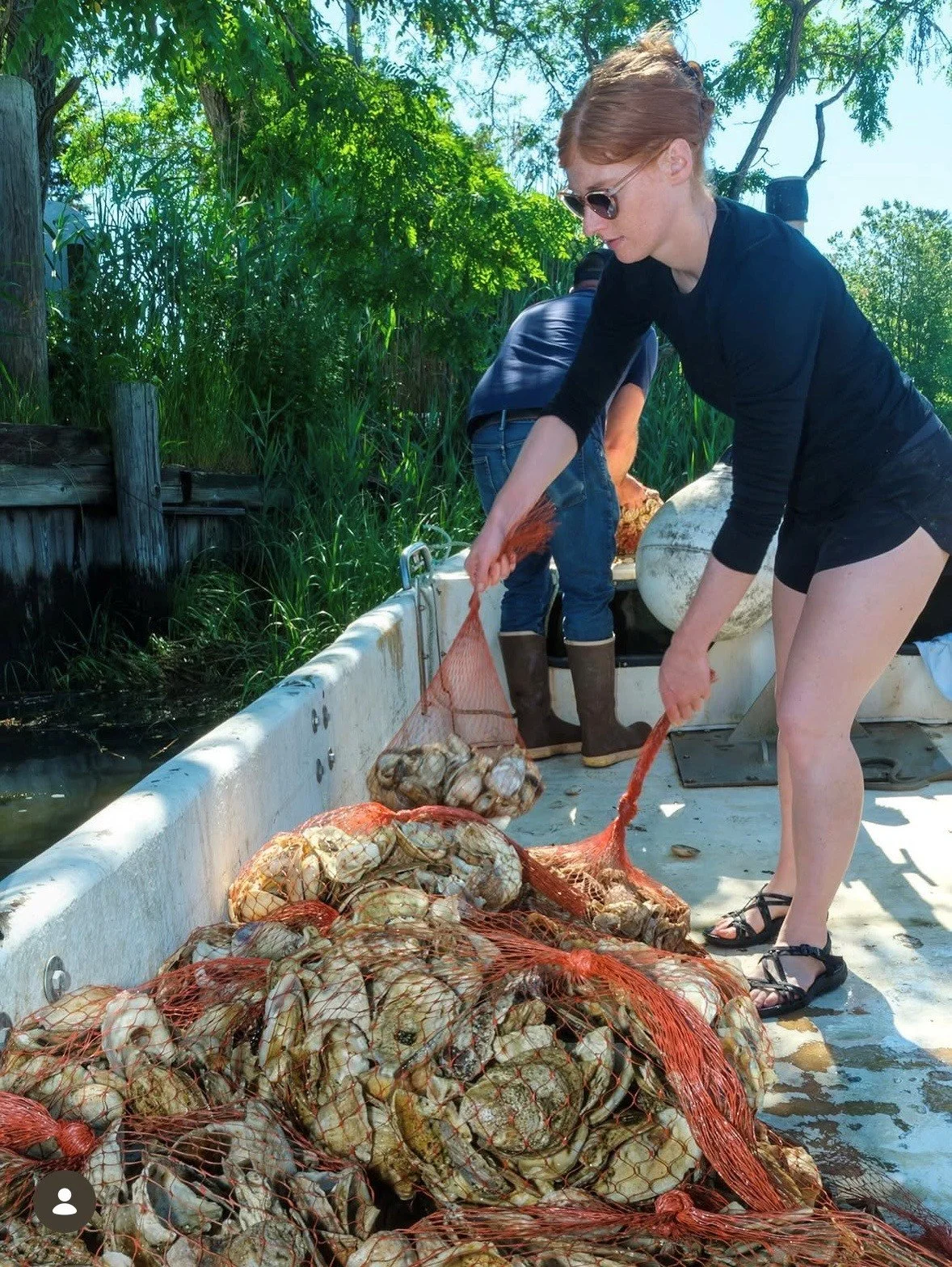
Grace Grimes combines a full-time administrative role with marine conservation work for South Fork Sea Farmers, a small nonprofit working on oyster restoration, aquaculture education, and community engagement. She has helped develop its shell recycling programme alongside volunteer coordination, partnerships, outreach, communications, and programme development. Her profile offers a perspective on non-linear routes into marine conservation, community-based work, and balancing a passion for ocean work with financial and personal stability.
Profile snapshot
- Role: Oyster restoration at South Fork Sea Farmers
- Organisation type: NGO / nonprofit
- Country / region: USA / North America
- Topics: Restoration; Coastal communities; Education and outreach; Stakeholder engagement; Conservation; Fisheries and Aquaculture
Jump to
Your current role
What is your current role, and what kind of organization do you work for?
I currently work two jobs. From 8:00 a.m. to 5:00 p.m., I work administratively for a landscape company, where I draft contracts, schedule crews, and assist project managers. After hours, I work for a small nonprofit called the South Fork Sea Farmers (SFSF). SFSF has been around since 2016, but I have had the exciting opportunity of being their first employee. The organization focuses on several areas of oyster restoration, aquaculture education, and community engagement. We co-host an oyster gardening program with a local town, run an internship program for high school students, provide an annual scholarship for graduating seniors interested in pursuing a marine-related field, and operate a shell recycling program that collects discarded oyster shells from local restaurants so they can eventually be returned to the water to help rebuild oyster reefs.
The shell recycling program is where I spend most of my time. My role has grown alongside the program, so I do a little bit of everything: volunteer coordination, restaurant partnerships, outreach, communications, and program development.
What does a typical week look like?
A typical week is hard to define because this is my second job. I am constantly juggling SFSF with my full-time job, exercise, meal prep, friendships and family, household chores, and what I jokingly call the "Hamptons Hustle"—the assortment of odd jobs that come with living in a very expensive place. Luckily, I work with SFSF as a contractor, so I have a lot of flexibility in determining my hours and capacity each week.
When I first started, much of my time was spent physically growing our shell recycling program. We had only a handful of participating restaurants and two volunteers, so as new restaurants joined, I was collecting a large portion of the shells myself in my little Ford Fusion. It quickly became very stinky and very unsustainable!
As the program has grown, so has our volunteer network. Having volunteers take ownership of weekly shell pickups has allowed me to shift more of my attention toward strengthening the organization itself: creating systems, developing educational resources, building partnerships, recruiting volunteers, and dreaming up new ways to get people excited about oysters and their local environment. For example, I created a geocache at one of our shell recycling trailers, I'm finishing a bilingual library backpack program that families can check out to learn about aquaculture and oysters, and this winter I hope to help construct an oyster-themed parade float.
There really isn't a "typical" week—and that's one of the things I love about it. I'd say that kind of variety is true of working at many nonprofits. Your work often changes depending on the grants, funding, and priorities you have at the time. And because resources tend to be limited, you often find yourself learning how to do things that a larger company might have the budget to outsource.
What skills do you use most often in your role, including any technical, practical, or soft skills?
The two skills I use most often might sound unconventional: excitement and conversation. I'm often tired but I'm genuinely excited about what we're doing, and I've learned that enthusiasm is contagious. When I bring energy and joy to a project, other people often want to become part of it too. That has been incredibly important for building momentum and getting community members interested in oyster restoration.
I also depend heavily on communication and relationship-building. Our volunteers make this work possible, and volunteers come with different personalities, schedules, motivations, and communication styles. Keeping people engaged—and occasionally navigating misunderstandings or conflict—requires patience, flexibility, and the ability to connect with many different kinds of people. I've learned that conservation isn't only about understanding ecosystems. A huge part of the work is understanding people.
Every job has a best part and a worst part. What are they for you?
My favorite part is collaboration. Since much of my 8-to-5 job is spent typing at a computer, I love that my work with SFSF gives me an opportunity to expand my community. The hardest part is actually the flip side of what makes the position so exciting. As the first and only employee, I have a tremendous amount of freedom—but that also means there isn't always a roadmap. I'm learning as I go. Sometimes I make mistakes, and I can get anxious wondering whether I'm making the "right" decision. I'm learning to become more comfortable with the fact that building something new inherently involves trial and error. Not every idea is going to work perfectly the first time.
Who else do you work with or depend on to get your job done?
Marine conservation requires working with a wide range of people: municipalities, scientists, fishermen, farmers, funders, and community members. My experiences living and working in very different places from farming in the desert, to working with oystermen, to communicating with high-profile clients in the Hamptons have taught me how to connect with people who have very different backgrounds, priorities, and perspectives.
If you're interested in the management or community side of conservation, I highly recommend taking classes in conflict mediation and facilitation. Knowing how to listen, find common ground, and navigate uncomfortable situations has been just as valuable to me as many of my science courses.
Your route into this work
How did you get into this work, and were there any key opportunities, decisions, or turning points along the way?
My path into marine biology has been anything but linear. My love for the environment started with family camping trips and afternoons fishing with my dad in Michigan. Some of my favorite memories are of being out on the water with him, but I also remember learning about pollution in local waters and precautions around how much of the fish we caught was safe to eat. Those experiences made me curious about what was happening beneath the surface and how people affect the ecosystems around us. As I learned more about the water around me, I became fascinated by the ocean. I read constantly about marine life, dreamed about living near the coast, and became determined to find my way into marine science.
When it came time for college, I had my heart set on going to Maine to study oceanography, but staying in Michigan ultimately made more sense. And I'm grateful I did. I had an incredible undergraduate experience and formed friendships with professors and students that I still maintain today.
I spent several years applying for summer research opportunities in ocean-side states because I was determined to get closer to marine science. I was consistently rejected, so I pivoted. Instead of waiting for the "perfect" marine opportunity, I built the skills I thought I might need someday. I earned my PADI Advanced Open Water certification, gained experience on the water through the sailing team, and learned transferable field sampling techniques in methodology courses.
At the same time, I followed the opportunities that were available to me, which happened to involve food systems. I volunteered in a community hoop house and through a local movement, "Decolonizing your Diet," began learning that food systems aren't only ecological systems—they're cultural systems too. I spent one summer working in the Rocky Mountains, where living and working with strangers in the backcountry became my first real lesson in navigating conflict and different personalities. The following summer, I returned to Colorado to work on an heirloom grain and vegetable farm specializing in seed saving. After graduating, I worked at a year-round farmers market whose mission was to create better economic opportunities for small-scale farmers.
But I still wanted to get to the ocean. My previous experience as a camp counselor and educator eventually helped me land my first marine job on Galveston Island with a small environmental nonprofit. Our work changed depending on the grant, but our overarching focus was combining art and science. I led work through an EPA-funded project building pocket prairies and rain gardens on middle-school campuses in Houston and assisted with NOAA B-WET-funded dune restoration projects on public beaches.
The work was dynamic and I learned a tremendous amount, but I wanted to be a part of enacting environmental change now rather than educating the next generation and passing the issues along. That realization led me to graduate school.
My undergraduate education had focused largely on ecology and understanding the natural world. For graduate school, I deliberately wanted to learn more about people, environmental management, and conflict. I found an opportunity through the State University of New York College of Environmental Science and Forestry and New York Sea Grant that combined almost everything I had been searching for: food systems, marine biology, art, community, and environmental management.
My graduate coursework focused on areas including environmental campaign building and conflict mediation, while my research brought me into conversations with oyster farmers, baymen, homeowners, environmental organizations, municipalities, and other people affected by or interested in aquaculture across Long Island. I worked with different stakeholder groups to understand which ecosystem services provided by oysters excited them, what made them hesitant about the growth of oyster aquaculture, and where there might be common ground. That work gave me something just as important as my degree: a community on Long Island.
After graduating, I started chasing the next opportunity—and then found myself on a longer pause than I expected. After moving around the country for different jobs and experiences, I became less willing to pack up and move anywhere for the sake of my career. I also started thinking more seriously about balancing passion with financial stability. So my career currently looks a little unconventional. I work full-time for a landscape company in the Hamptons while continuing to build my marine conservation experience through SFSF.
I'm currently focused on expanding my breadth of marine work. I've volunteered with an organization rehabilitating cold-stunned sea turtles, am on call and trained to respond to marine mammal strandings, and this summer I've even been lucky enough to get out on a shark-tagging boat.
For years, I’ve felt like I was trying to find my way into marine biology. I’m not quite where I want to be yet, but looking back at all the experiences I’ve pieced together, I finally feel like I’m getting close.
What education, training, or experience helped you get into this role?
I have a bachelor’s degree in biology focused on ecology and a master’s degree in environmental science focused on environmental conflict. Beyond formal education, much of my training has come through hands-on experience, and volunteering. I’m continually expanding my skill set, and I don’t think that process ever really stops in this field.
Is there any education, training, or experience you wish you had done or gotten?
I wish I had invested earlier in some of the less glamorous technical skills, particularly GIS, coding, and data analysis. Those skills don't necessarily sound as exciting as getting out on a boat or restoring habitat, but they can dramatically expand the types of positions you're qualified for—including remote and hybrid positions. That can provide much more flexibility in your personal life and make it easier to build a sustainable long-term career in conservation.
Reflections and advice
What advice would you give someone interested in this kind of work, and where should they look for their first step?
Firstly, talk to people. Network, ask questions, reach out to people whose work interests you, and build genuine relationships. You truly never know where a connection will lead. Even simply following scientists and organizations on LinkedIn can expand the breadth of opportunities you're exposed to.
Secondly, think about place, not just job titles. Research places where you could genuinely see yourself living and start building community there. Attend public lectures, volunteer days, conferences, restoration events, and community meetings. I've found that many opportunities emerge from being present and becoming part of a place.
And finally, don't assume your path has to be linear. If the exact opportunity you want isn't available yet, look at the opportunities adjacent to it. The skills you gain somewhere unexpected may end up being exactly what distinguishes you later.
If you could go back in time, would you do anything differently?
I would learn about personal finance earlier. Financial literacy wasn't something I was taught about extensively, and I think it deserves a much bigger place in conversations about careers in conservation. Most people enter marine science because they're passionate about the environment and want to make a difference, but it’s important to balance that with stability.
I wish I had understood earlier how benefits, retirement contributions, and long-term savings fit into career decisions. Different sectors within marine science and conservation can make financial stability easier or harder, and I think it's worth considering those realities while exploring your pathway—not because money should determine everything, but because building a sustainable life can help you stay in the work you care about for the long term.
Is there anything else you’d like to say?
I'm still early in my career myself, and I'm very much figuring things out as I go. But I'm always happy to talk with anyone who has questions, is exploring a similar path, or wants to collaborate. One of the greatest things this field has given me is community, and I'm always excited to expand it.