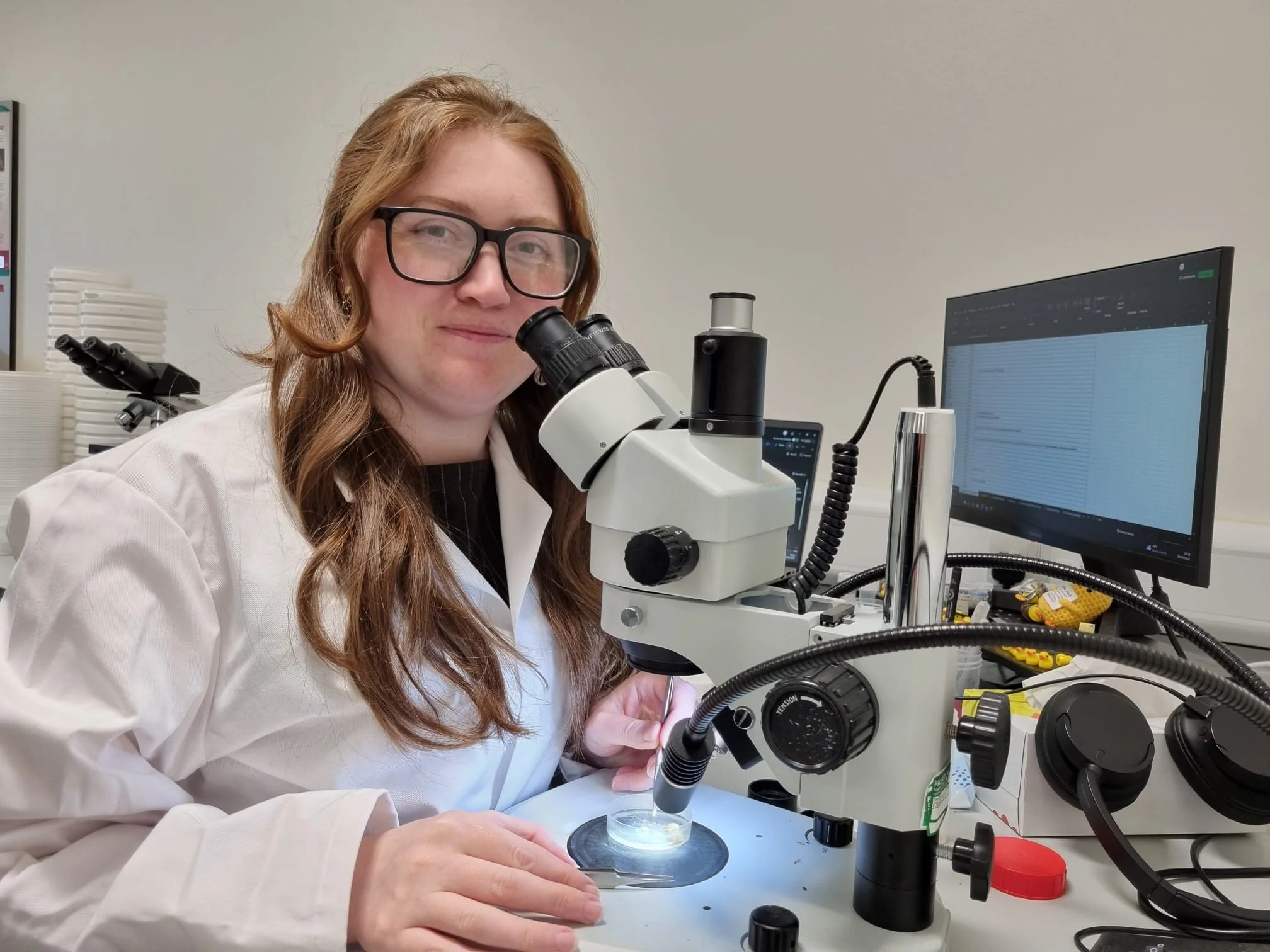
Emma Knowles is an Assistant Marine Taxonomist working for Ocean Ecology Limited. Their work centres on processing benthic samples, identifying marine species using taxonomic keys and microscopes, quality checking samples, and helping train colleagues. Emma’s route into marine taxonomy includes caring responsibilities, returning to education through an Access to Higher Education diploma, and gaining experience through several different roles before moving into taxonomy.
Profile snapshot
Role: Assistant Marine Taxonomist
Organisation type: Private company
Country / region: UK / Europe
Role type: Technician / technical specialist
Focus areas: Taxonomy; Marine life
Jump to
Your current role
What is your current role, and what kind of organisation do you work for?
In my current role on paper, I am an Assistant Marine Taxonomist, but I perform the role of a Marine taxonomist as I am on track to move into this position. I work for Ocean Ecology Limited, which has recently been acquired by DNV, both of which are private companies.
What does a typical week look like?
I work Monday to Friday, often starting somewhere between 8-9am and finishing around 4-5. The company has a flexitime schedule where we can start between 8-10am and finish between 4-6pm. We have two laboratories: one for preparing the samples and one for processing the samples.
We all take it in turns to sieve samples, so one morning a week I will sieve the samples for the project we are working on that week. Typically, samples are sieved down into 4mm, 2mm and 1mm fractions. Each sample is then taped up with a colour assigned to that project and placed into the main lab for processing.
The main lab is where I spend most of my time as this is where the identification takes place. Samples are first picked; this means anything that is biological is picked out of the sample and separated either into major groups or as far as we can take it at this stage, which is often to families. This process is done by the assistant marine taxonomists. This is then taken by the taxonomists and everything picked out is identified to species and the left-over residue is quality checked to ensure nothing is missed.
This is where I come in. I take all the specimens from a sample to species level using the taxonomic keys we have and quality check the samples. When I am finished with the identified species, it is then passed on to a senior member for quality control. I process many samples each week that it would be difficult to give an exact number of samples I process as each sample can vary in size and quantity of species.
What skills do you use most often in your role, including any technical, practical, or soft skills?
The most highly used skill in my job is the identification of species from reading and interpreting taxonomic keys. In the lab we use light microscopes and compound microscopes to do this. Communication is incredibly important in my role, both within my team in the lab and across teams, such as consultancy, survey and management because without proper communication, things can go wrong. Communication is key in teaching, as I often teach assistants how to identify species and use and understand the taxonomic keys, and in providing feedback on samples they have picked. I also train new members in the processes of picking and identification as part of my role.
Every job has a best part and a worst part. What are they for you?
There are so many aspects of my job that I love that it’s hard to pick a best part. Being able to identify species every day and process samples from so many different locations both in and out of UK waters is amazing. I truly love solving puzzles and my work very much feels like that, every sample is like a puzzle to solve, and I see such a variety of species that no day is ever dull. I have been doing this role for 3 years now and I still come across species that I haven’t seen before, and I get so excited at seeing the same species over and over again. This line of work is very repetitive, but I honestly don’t mind it. The people I work with in the lab are some of the bubbliest, kindest and energetic people I have ever met, and it truly makes each day a wonderful working day.
I adore doing taxonomy and my role so much that I am finding it so hard to pick a worst part! If I had to pick something, and it is a very small ‘worst part’ of my job, occasionally in samples we get these polychaetes (worms) called pectinarids, commonly known as ice-cream cone worms for the sandy tubes they create. Well, these polychaetes also create slime, which is used to bond the sand particles together. Sometimes when we get particularly large worms, they produce a lot that it makes the sample slimy and gooey and it’s very gross to me, I don’t really do well with snot-like stuff, it’s icky.
What is one task you do all the time that never appears in job descriptions for these types of roles?
Label, label and more labelling. Every single thing in the lab needs to be labelled appropriately so that other members know what it is and where it is to avoid any confusion and ensure a streamlined process. That can be chemicals, samples, species identified within samples, reports, packages. For the job, you are kind of aware that you will be writing labels or notes, but you don’t realise just how much of your time is spent writing labels for species until you start the job.
What does this job demand of your schedule or lifestyle?
For myself the job is a standard Monday-Friday working and weekends off. We have a pretty flexible schedule in terms of start and finish times, so long as we work during core hours and complete our contracted hours each week, which is great. Occasionally I do overtime (when the need arises) if we have multiple deadlines in a short turn-around time, but the work-life balance in this job is great.
Your route into this work
How did you get into this work, and were there any key opportunities, decisions, or turning points along the way?
When I was little, I would go pebble hunting with my grandad and after a while I started looking at the species on the shore too. One year he bought me my first rock pooling guide, and I became obsessed with marine biology. I selected GCSEs to fit my plan, and I went off to sixth form to do my A-levels. But this is where things took a turn, I initially failed my A-levels due to becoming a carer for my parents, then I dropped out to help them and work full-time.
After a few years when things got better at home, I still wanted to pursue my dream of becoming a marine biologist and so I went to college to do an Access to Higher Education diploma in science and this was a fantastic experience and I got into the University of Plymouth where I stayed for 4 years, completing my bachelor’s and my master’s degrees.
After my degrees I did a few different jobs, I started off surveying seals during pupping season and then moved into a chemistry job as an assistant inorganic chemist. Although this job was not marine based, it taught me valuable skills and experience that I may not have got otherwise. After this I took a position as a benthic megafaunal annotator for deep-sea mining in Southampton on a 1-year contract. I would say this was my first position in taxonomy, but it was done through images instead of under a microscope.
Nearing the end of my contract I started applying for jobs and I came across the company I now work for and although they didn’t have any active jobs listed, I sent my CV anyways and after an interview I got an offer for the position of Assistant marine taxonomist. I moved my life from Southampton to Oban in one weekend and have been here ever since. I believe that everything happens for a reason and that every job I took, no matter what it was, led me to where I am now and I am so grateful for every opportunity.
What education, training, or experience helped you get into this role?
I have a bachelor’s in Marine Biology and a master’s in Applied Marine Science from the University of Plymouth. I gained experience in taxonomy from my undergraduate degree and from volunteering on a Netflix documentary called ‘Night on Earth’ where I assisted in identifying species and providing knowledge about them. Although gaining experience is helpful, it isn’t always necessary to get into this line of work as often companies will offer graduate schemes or you can start out as a technician or an assistant where you will be trained and from there you can work your way up to various roles, just like I’m doing now. What you do need is a bachelor’s degree in a related science.
What is one opportunity you almost didn’t apply for, but are glad you did, and why?
Funnily enough it is the job I am doing now. There was no official advert out for a position, but I sent my CV anyways as there was a line on the careers page saying that although they didn’t have a position open, they love to hear from prospective candidates, so that’s what I did. Then a couple of days later I got offered an interview and a few days after that an offer. If I hadn’t sent my CV off, I wouldn’t be where I am today. It is always worth applying for an opportunity, you never know where it will take you.
Reflections and advice
What advice would you give someone interested in this kind of work, and where should they look for their first step?
My advice would be to network, make connections and to put yourself out there. I’m going to sound a little contradictory here, but I would advise gaining a variety of experience, because you never know what skills you learn from them will come in useful in the future.
I worked as a social media coordinator for a cephalopod charity and at the time I didn’t know it would come in so useful when in my current role I had to identify cephalopods from fish stomachs. The role didn’t seem like it connected to my current one, but there were some aspects from it that did and I am grateful for that.
If you are looking for your first job in taxonomy, I think the best way to do that is to look into companies and contact them directly to see if they have any openings or connect with others who work in the industry, on LinkedIn for example.
What is one mistake, challenge, or lesson from early in your career that taught you something useful?
I cannot speak for everyone in this industry, but it can be easy to focus on the negatives of feedback or mistakes you make when you first start out learning how to identify species and this is something I did at the beginning of my career. I focused too much on what I was getting wrong and saw this as a reflection of my ability to do the role, but alongside the species I wasn’t quite getting right were so many I was! It was easy to forget that those mistakes I was making were not a bad thing, they just showed me where I needed to focus and spend more time understanding what I was getting wrong. Mistakes are not a bad thing; they are there to help you and that was something I had to learn early in my career.
If you could go back in time, would you do anything differently? If so, what would that be?
No, every experience I have had, every job I have done and every decision I have made in regard to my marine biology journey has taught me something valuable and I would not change any of those experiences.