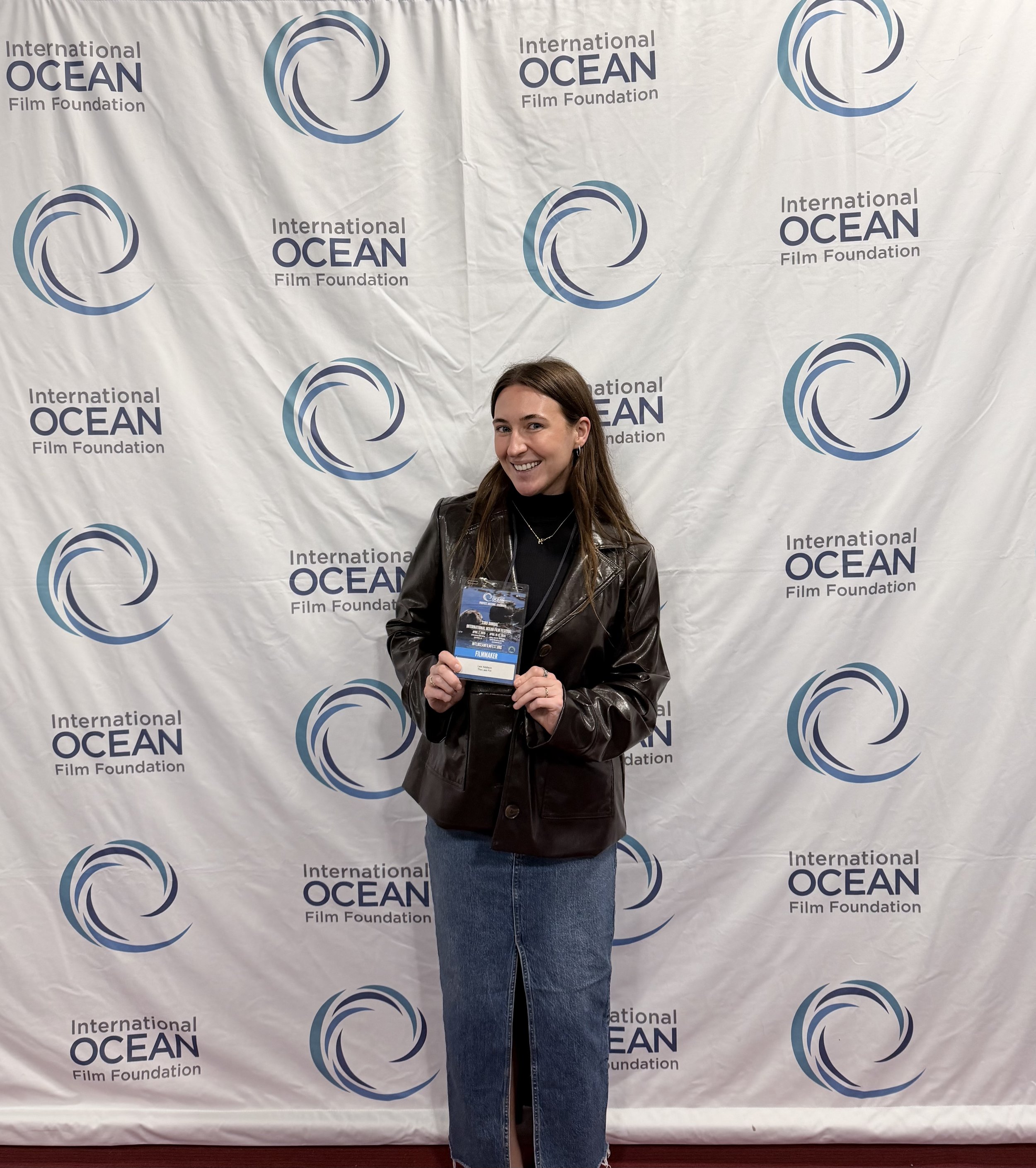
Lexi Addison is an Environmental and Sustainability Consultant at a private company in the USA. Alongside professional consulting work, Lexi pursues ocean conservation through photography, documentary filmmaking, and community-building. In this profile, Lexi explains how environmental policy, transferable skills, and independent creative projects can contribute to a career centred on the ocean.
Profile snapshot
Role: Environmental and Sustainability Consultant
Organisation type: Private company
Country / region: USA / North America
Role type: Consultant / Creative/media professional
Focus areas: Conservation, Filmmaking, Policy and governance, Science communication, Stakeholder/community engagement
Jump to
Your current role
What is your current role and what kind of organisation do you work for?
I’m an Environmental and Sustainability Consultant at a professional services firm. My work focuses on environmental policy, sustainability, conservation, and regulatory issues, often supporting government agencies and other organizations working through complex environmental challenges.
Outside of my consulting role, I’m also an ocean conservationist, photographer, and self-taught documentary filmmaker. I create films and visual stories that explore issues affecting our ocean, particularly the connections between people, marine ecosystems, and the decisions that shape their future. I’m especially interested in sustainable fisheries, community-centered ocean management, and finding ways to make ocean science and policy more accessible through storytelling.
My career spans a few different areas, but they all connect back to a common interest: how we can better protect the environment while working with the people and communities who depend on it.
What does a typical week look like?
No two weeks look exactly the same, which is something I enjoy about my work. In consulting, I might spend one day researching environmental regulations and assessing how they affect a project, another coordinating with a team on deliverables and timelines, and another preparing presentations or working through environmental challenges with clients and colleagues. A lot of my work involves bringing together information from different sources, managing competing priorities, and helping turn complex environmental issues into practical recommendations.
Outside of work, I dedicate time to my ocean projects. That might mean editing a documentary, researching an issue I want to tell a story about, developing content, connecting with other ocean professionals, or volunteering with organizations working toward ocean conservation. I’m also involved in ocean community-building initiatives that connect early-career professionals and help people find opportunities in the field.
Balancing these different interests takes planning, but I like that my work allows me to approach ocean conservation from multiple angles. Not every part of conservation happens in the water; some of it happens through policy, communication, relationship-building, and the decisions made behind a desk.
What skills do you use most often in your role, including any technical, practical, or soft skills?
Research, critical thinking, writing, and communication are probably the skills I use most consistently. I spend a lot of time making sense of complex information, identifying what matters, and communicating it in a way that different audiences can understand.
Project management is another big one. Keeping projects moving requires organization, attention to detail, managing timelines, coordinating with different people, and being comfortable adapting when priorities change. Stakeholder engagement is also important because environmental work rarely happens in isolation. You need to understand different perspectives and find ways to work toward a shared goal.
My ocean work draws on many of these same skills, but in different ways. Filmmaking requires visual storytelling, photography, research, editing, and the ability to build a narrative around a complicated issue. It also requires patience, adaptability, and a willingness to figure things out independently.
I’ve found that skills are transferable across sectors in ways you might not expect. The ability to research an issue, communicate clearly, manage a project, and work with different people is just as valuable in conservation as it is in consulting.
Every job has a best part and a worst part. What are they for you?
The best part is getting to work on environmental challenges that matter and learning from people with different areas of expertise. I enjoy the problem-solving side of consulting and the opportunity to understand how policy, planning, and decision-making can influence environmental outcomes. In my ocean work, the most rewarding part is being able to tell stories that might help someone see an issue differently or feel more connected to the ocean.
The hardest part is that meaningful environmental work can be complicated and slow. There are often competing priorities, layers of regulation, and many different stakeholders involved in making decisions. It can take a long time to see the results of the work, and sometimes the connection between what you do day to day and the bigger environmental outcome isn't immediately visible.
I also think one of the challenges of building a career in ocean conservation is figuring out how to bring the work you care about into your professional life in a sustainable way. There are so many important issues to work on, but finding the right role, opportunities, and financial stability can take time.
What is one task you do all the time that never appears in job descriptions for these types of roles?
Translating between people who approach the same environmental issue from completely different perspectives. You might be working with someone focused on regulations, someone thinking about project budgets, and someone concerned about the effects on a local community. A big part of the work is understanding what each person needs, identifying where their priorities overlap, and communicating in a way that makes progress possible.
I also spend a surprising amount of time organizing information, following up with people, and keeping track of small details that help a much bigger project come together.
What does this job demand of your schedule or lifestyle (travel, field seasons, on-call work, etc.)?
Consulting is largely project-driven, so the schedule can get busy around deadlines, and balancing multiple projects requires flexibility and good time management. My ocean filmmaking and advocacy work happens alongside my full-time job, which means I often dedicate evenings, weekends, and personal time to filming, editing, networking, and developing projects.
My hands-on marine experiences have looked very different from my consulting work. Research and field opportunities can involve travel, long days, early mornings, and working around weather, tides, and the behavior of wild animals. Documentary filmmaking adds another layer because you can't always control when something will happen or how long it will take to capture a story.
One thing I've learned is that working in ocean conservation doesn't necessarily mean spending every day in the ocean. There are many ways to contribute, and each comes with a different lifestyle.
Who else do you work with or depend on to get your job done (other roles, disciplines, agencies)?
My consulting work involves collaborating with people across environmental science, policy, regulatory compliance, project management, engineering, and sustainability, as well as clients and government agencies. Environmental challenges are rarely confined to one discipline, so having people with different expertise is essential.
In the ocean space, I've learned from and collaborated with marine researchers, fisheries professionals, conservation organizations, local communities, filmmakers, communicators, and people working directly with coastal communities. I've also been involved in networks that bring together early-career ocean professionals from different backgrounds and countries.
I really value these connections because ocean conservation needs more than scientists alone. We need people who can communicate research, understand policy, work with communities, influence decision-making, and bring different perspectives to the same problem.
Your route into this work
How did you get into this work, and were there any key opportunities, decisions, or turning points along the way?
I've always been interested in the natural world, but my path into ocean conservation has been a combination of education, hands-on experience, and figuring out how I wanted to contribute.
I studied Environmental Studies, with a focus on policy, law, and politics, as well as Political Science. I was interested not just in environmental problems themselves, but in why they happen, how decisions are made, and what it takes to create change. That led me to pursue a master's degree in Coastal Environmental Management at Duke University, where I explored ocean policy, fisheries management, marine conservation, and the relationship between coastal communities and the environments they depend on.
Some of my most formative experiences came from working directly in marine conservation. At the Bimini Biological Field Station in The Bahamas, I gained experience connected to shark research and learned more about the ways human activities affect marine wildlife. I also worked with Shark Stewards, where I supported marine policy work related to shark fishing and the trade in shark and ray products.
Those experiences helped me understand that protecting the ocean requires more than research. Science is essential, but so are effective policies, community engagement, communication, and an understanding of the economic and social realities surrounding conservation.
I eventually moved into environmental consulting, where I've been able to develop skills in environmental policy, regulatory analysis, project management, and working across disciplines. At the same time, I began developing my own documentary filmmaking practice as a way to explore ocean issues that mattered to me.
Looking back, my path hasn't been a straight line into one specific ocean job. It's been about building a set of skills and finding different ways to apply them to the issues I care about. I'm still figuring out what the next chapter looks like, but I know I want my work to continue connecting ocean conservation, policy, communities, and storytelling.
What education, training, or experience helped you get into this role?
My undergraduate degree in Environmental Studies gave me a foundation in environmental science, policy, law, and politics. My master's degree in Coastal Environmental Management helped me specialize in marine and coastal issues and better understand the connections between ecological systems, human communities, and environmental decision-making.
Beyond formal education, my field experiences were incredibly important. Working around shark research in Bimini and supporting marine policy work with Shark Stewards gave me a more practical understanding of conservation challenges and helped me explore different sides of the field.
My consulting experience has also been a major part of my development. I've built skills in research, environmental regulations, stakeholder engagement, project management, and communicating complex information. These skills have opened doors to work on environmental challenges beyond the marine sector and are highly transferable to ocean conservation.
For filmmaking, I am entirely self-taught. I learned through doing: researching stories, filming, editing, experimenting, and figuring out how to bring an idea from the initial concept all the way through to a finished documentary. That process has taught me a lot about taking initiative and being willing to learn as I go.
I don't think any single degree, internship, or job prepared me for everything I do now. It has been the combination of formal education, practical experience, and independent projects that has shaped my career.
Is there anything people think they need for this career that may not actually be essential?
I think people sometimes assume they need to have their entire career mapped out, a very specific degree, or years of experience before they can contribute meaningfully. I certainly didn't have everything figured out when I started.
You don't necessarily need a marine biology degree to work in ocean conservation, and you don't have to spend every day in the water. There are opportunities in policy, communications, filmmaking, community engagement, law, finance, project management, and many other areas.
You also don't need to wait until someone gives you a formal job title to start contributing. You can build experience through volunteering, independent projects, professional networks, and collaborations.
My filmmaking journey is a good example. I didn't have formal training or wait for a production company to hire me. I started creating stories with the equipment and skills I had, then kept learning. I think initiative, curiosity, and a willingness to learn can take you a long way.
Reflections and advice
What advice would you give someone interested in this kind of work, and where should they look for their first step?
My biggest advice is to get specific about the issues you care about, but stay open-minded about how you might contribute to them.
It's easy to assume that working in ocean conservation means becoming a marine biologist or getting a job with a conservation nonprofit. Those are absolutely valuable paths, but the field also needs people who understand policy, communications, law, business, community engagement, and project management. Think about the skills you already have and how they might be useful in the ocean space.
I'd also encourage people to seek out practical experience as early as possible. That could mean an internship, volunteering with a local environmental organization, supporting a research project, attending an event, or creating a project of your own. You don't have to wait until you've graduated or landed your dream job to start building connections and learning about the field.
Networking can feel intimidating, especially when you're early in your career, but it doesn't have to mean asking strangers for jobs. Reach out to people whose work genuinely interests you, ask thoughtful questions, and be curious about how they got where they are. Some of the most useful conversations are simply opportunities to learn about paths you didn't know existed.
I'd also recommend following ocean organizations and professional networks that share opportunities, events, and resources. Early-career networks can be particularly useful because they connect you with people navigating similar questions and help you realize you're not the only one figuring things out.
Finally, don't underestimate transferable skills. Your first job doesn't have to be your forever job, and every experience can help you build something useful for the next step. My own career has developed through a combination of formal education, consulting, marine experiences, and
independent creative projects. There isn't one correct route, and you don't have to fit neatly into one category to make a difference.
If you could go back in time would you do anything differently? If so, what would that be?
I'd probably spend less time worrying about whether I was following the right path and more time exploring opportunities that genuinely interested me.
When you're studying or starting your career, it can feel like every decision determines what you'll be able to do for the rest of your life. In reality, careers are much more flexible than they appear. The skills you build, the people you meet, and the experiences you have can lead you in directions you couldn't have predicted.
I'd also encourage my younger self to start creating and sharing work sooner, even if it wasn't perfect. You learn so much more by making something, putting it out into the world, and improving with each project than by waiting until you feel completely ready.
Is there anything else you'd like to say?
I'd love for more people to recognize that there are many ways to build a meaningful career around the ocean. My own path has brought together environmental consulting, marine conservation, policy, photography, and filmmaking, and I'm still exploring how those pieces can come together.
You don't need to have everything figured out, and you don't have to do everything the same way as the person next to you. Sometimes the most interesting opportunities come from following a curiosity, developing a skill, or saying yes to something that takes you in an unexpected direction.